


From the outside, Canada still looks like a functioning democracy. Elections are held on schedule, Parliament convenes, and parties campaign against one another. The trouble is that almost none of it functions as advertised.
Today, Canada’s “democracy” operates as a procedural husk — a system that retains every formal structure of democratic governance being repurposed to serve the political class rather than the public it claims to represent.
Over the past five years, the governing party has called elections to bury active investigations into national security breaches and financial corruption. Parliament sat for just sixteen percent of the available days while MPs collected full salaries and per diems for the other eighty-four.
More than 121,000 ballots went uncounted in a single federal election. A riding was decided by one vote after an Elections Canada employee printed the wrong postal code on dozens of ballot envelopes — and the Supreme Court had to annul the result. A 298-vote Conservative lead in another riding disappeared overnight and surfaced as a 29-vote Liberal win, chalked up to “data entry errors.”
A foreign power interfered in two consecutive federal elections, funded at least eleven candidates, and faced no meaningful consequence. A sitting Liberal MP publicly encouraged people to collect a bounty placed by the Chinese Communist Party on a Conservative candidate. The current Prime Minister was initially installed by 131,674 Liberal Party members — roughly one-third of one percent of the Canadian population — and governs with a cabinet largely comprised of people who served the man that resigned in disgrace before him. And in the months since, five Members of Parliament elected under one banner have crossed the floor to hand that Prime Minister an impending majority no Canadian voter ever granted.
Not one of these events has triggered a constitutional crisis. The Governor General has not intervened, the courts have addressed only the most egregious case, and the media has covered each as an isolated story — a bad recount here, a questionable floor crossing there, a foreign interference inquiry that found “troubling” events but assured Canadians the overall outcome was not affected.
That is how a democracy dies. Through a slow and methodical dissolution of integrity, where each violation is absorbed, normalized, and filed away as an exception rather than recognized as part of a pattern.

This piece documents the pattern. Over the following sections, we trace a five-year arc of democratic erosion in Canada, from the Winnipeg Lab cover-up in 2021 through the manufactured majority likely to take hold next week. Every claim is sourced and every event is a matter of public record. Taken in isolation, any one of them could be dismissed as an anomaly. Taken together, they form a case that the country’s democratic institutions have not merely failed. They have been repurposed. While the husk may still remain, the substance is gone.
Elections as Escape Routes
There is a question Canadians ought to ask every time a federal election is called: what was Parliament about to find out?
In the summer of 2021, the House of Commons was closing in on one of the most serious national security breaches in Canadian history. Dr. Xiangguo Qiu and her husband Keding Cheng — both scientists at the National Microbiology Laboratory in Winnipeg, Canada’s only Biosafety Level 4 facility — had been fired in January of that year after CSIS determined that Qiu had “intentionally” worked to benefit the People’s Republic of China. The scope of what she had done was staggering. Qiu transferred live Ebola and Henipah viruses to the Wuhan Institute of Virology, collaborated with People’s Liberation Army Major-General Chen Wei on published research, allowed PLA-affiliated personnel access to Canada’s highest-security lab, and was listed as co-inventor on two Chinese government patents for innovations related to the Ebola and Marburg viruses — work that was the direct product of her position inside a Canadian government facility.
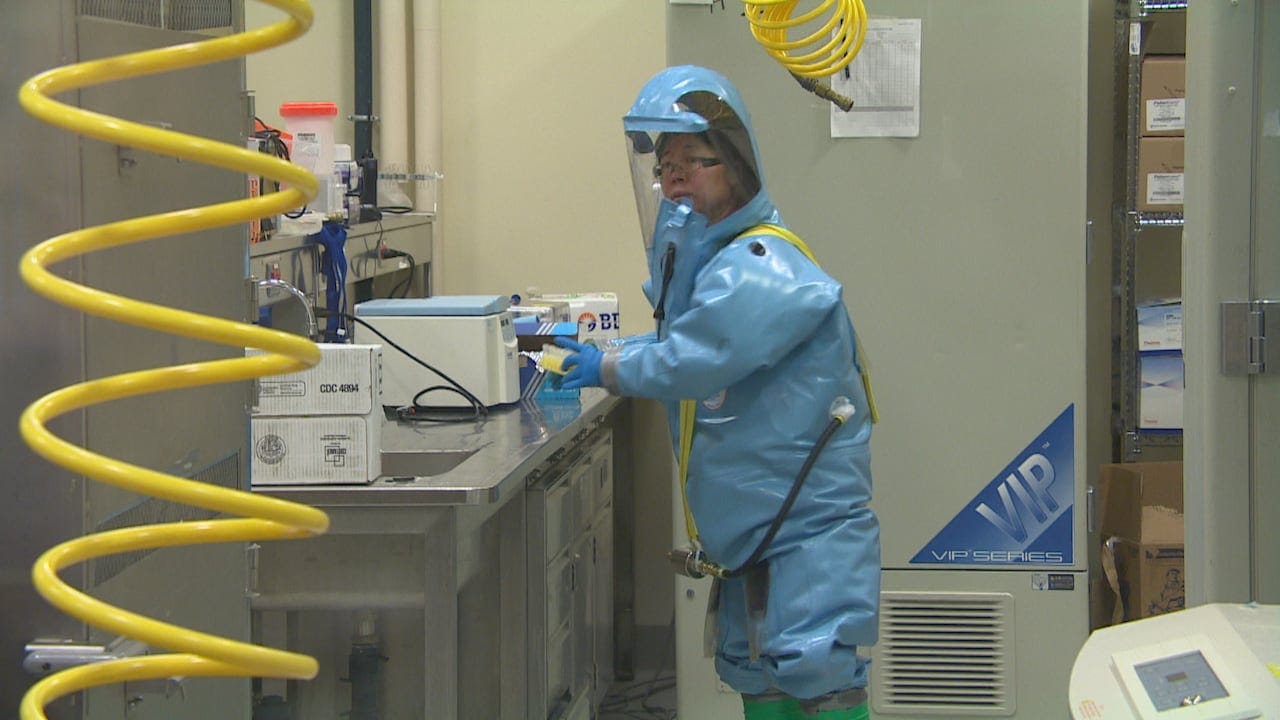
The House of Commons demanded answers. Opposition MPs passed a motion ordering the government to produce unredacted documents about the firings and the security breach. The Trudeau government refused. The House ordered it again. The government refused again. Over the course of months, four separate orders of Parliament were defied — a level of contempt for the legislative branch that has almost no precedent in Canadian history. When the Speaker of the House ruled that parliamentary privilege had been breached and prepared to enforce disclosure, the government did something extraordinary: it took the Speaker of the House of Commons to Federal Court to get a judge to block the release. The executive branch of government sued the legislative branch of government to prevent Canadians from learning what had happened inside their own national laboratory.
And then, before any of it could be resolved, Trudeau called a snap election in August 2021. The dissolution of Parliament killed all four House orders, ended the court challenge (which the government quietly withdrew during the campaign), and buried the investigation entirely. A Special Committee would eventually reconvene and produce a report with twelve recommendations — including adding the Wuhan Institute of Virology to Canada’s list of Named Research Organizations — but by then the political moment had passed. The documents were not produced during the election. The public moved on. The RCMP investigation into Qiu and Cheng remains open with no charges laid.
Three years later, the pattern repeated.
In June 2024, the Auditor General released a report on Sustainable Development Technology Canada — a federal foundation responsible for distributing hundreds of millions in public funds to clean-tech companies. The findings were damning. The AG found that SDTC had awarded $334 million across 186 cases in which board members held direct conflicts of interest, $59 million to ten projects that were entirely ineligible for funding, and an additional $58 million to projects where basic terms and conditions were never verified. Internal whistleblowers had secretly recorded a senior civil servant describing the mismanagement as “outright incompetence.” In total, roughly $390 million in taxpayer money was either misappropriated or awarded under conditions that should have disqualified it from the start.
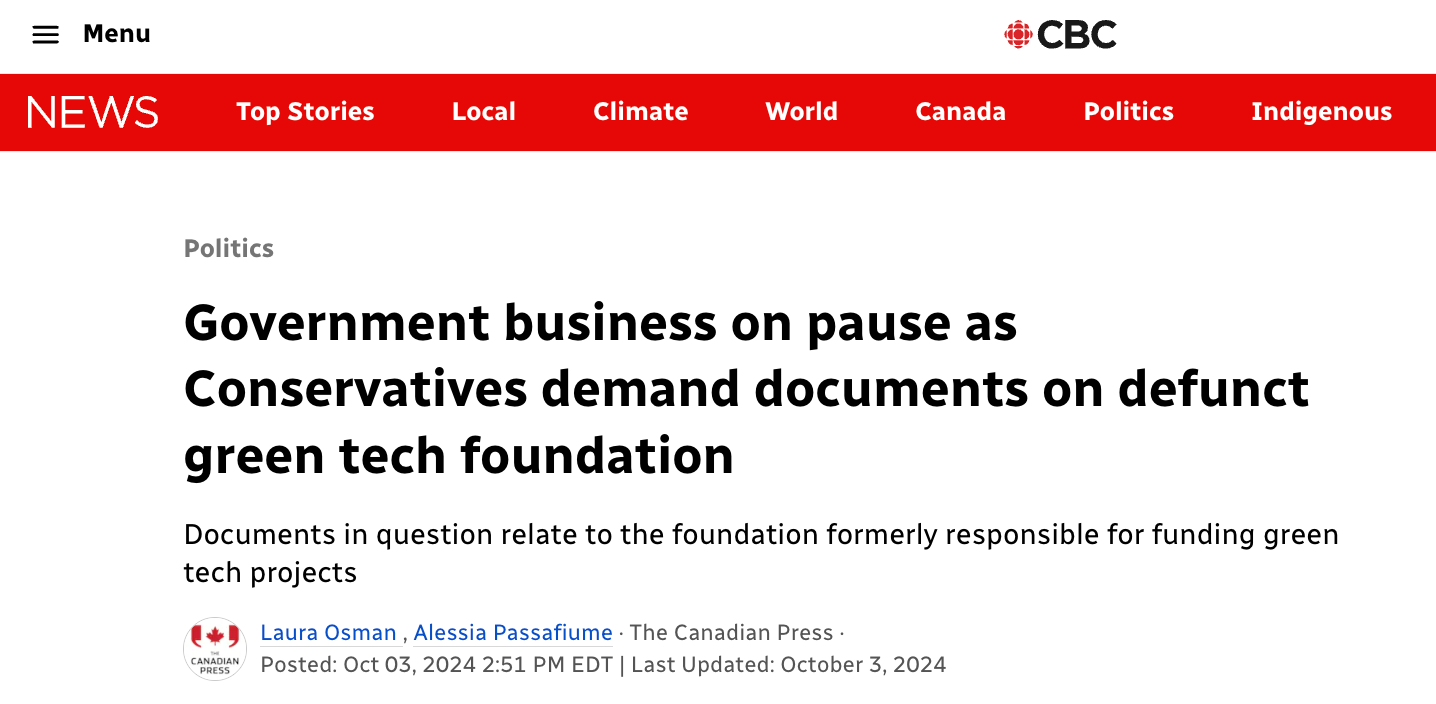
The House of Commons passed a motion ordering the government to produce unredacted documents related to the scandal and to refer the matter to the RCMP for potential criminal investigation. The Liberals refused. The Speaker ruled that the government had “clearly not fully complied” with the order. The Conservatives seized the House with a privilege debate, and all legislative business ground to a halt on October 3, 2024. Rather than produce the documents, the government chose to let Parliament die. The House did not sit for a single productive day from that point until well into 2025 — a stretch of nearly eight months during which Canadians were governed without a functioning legislature.
The same playbook, twice in four years. An investigation reaches the point where disclosure becomes unavoidable, and the governing party reaches for the kill switch — dissolution in 2021, procedural paralysis in 2024. In neither case were the documents produced. In neither case did the public receive a full accounting. And in both cases, the mechanism that was supposed to hold the executive to account — Parliament itself — was neutralised by the very people it was meant to hold accountable.
The election is supposed to be the tool citizens use to enforce accountability on their government. In Canada, it has become the tool the government uses to escape it.
The Integrity of the Vote
Even if you set aside the corruption and the cover-ups — even if you accept the premise that Canadian elections are still called in good faith — the machinery of the vote itself is broken.
In the 2025 federal election, more than 121,000 special ballots went uncounted. Out of roughly 1.3 million mail-in ballots issued, nearly one in ten never made it into the tally. Elections Canada has not provided a clear breakdown of how many were misdirected, how many arrived late, and how many were simply never returned — a distinction that matters enormously when the integrity of an election depends on public confidence that every eligible vote was counted. CBC reported on the scale of the problem, but no satisfactory explanation has followed. The ballots were issued but not counted. And the country moved on as though that were normal.
In the Quebec riding of Terrebonne, it was worse than normal. Liberal candidate Tatiana Auguste defeated Bloc Québécois candidate Nathalie Sinclair-Desgagné by a single vote — the narrowest margin in the country. The result might have stood had it not emerged that an Elections Canada employee had printed his own postal code on at least forty special ballot envelopes, causing them to be misdirected. One of those ballots belonged to a confirmed Bloc voter whose vote was rejected because it arrived at the wrong returning office. Quebec’s special ballot rejection rate ran between two and six times the national average. Over 800 ballots in British Columbia were never counted at all. The Bloc filed a legal challenge, and a Superior Court judge initially ruled against overturning the result. The Supreme Court of Canada disagreed, annulling the election and ordering a byelection for April 13, 2026. It took the highest court in the country to acknowledge what should have been obvious from the start: a riding decided by one vote, in an election where the administering body itself caused valid ballots to be rejected, is not a legitimate outcome.
Then there is Milton East–Halton Hills South, which may be the most troubling case of all. On election night, Conservative candidate Parm Gill led by 298 votes. It was not a razor-thin margin. It was a clear and comfortable win by any normal standard of Canadian electoral math. Then came the validation process. Elections Canada reported that Liberal candidate Kristina Tesser Derksen had in fact won the seat by 29 votes — a swing of 327 votes, all moving in the same direction, attributed entirely to “data entry and calculation errors.” A judicial recount overseen by Justice Leonard Ricchetti confirmed the Liberal win, narrowing the margin to 21 votes. Elections Canada issued a formal announcement and the result was certified.
What was never adequately explained is how a 298-vote lead transforms into a 29-vote deficit through clerical errors alone. Errors in vote tabulation are not uncommon — small discrepancies surface in virtually every recount — but they tend to distribute randomly across candidates. A uniform directional swing of 327 votes, every single one of which moves from one candidate to the other, is not a random distribution. It is a statistical pattern that demands a better explanation than the one Canadians received.
Three ridings. Three different failures. In Terrebonne, an employee’s mistake disenfranchised voters in a riding decided by the smallest possible margin. In Milton East, a candidate who won on election night lost his seat through a validation process that no one has convincingly explained. And across the country, 121,000 ballots were issued and never counted, with no public accounting of why.
The ballot is the most basic unit of democratic power. It is the one moment where every citizen is supposed to stand as an equal — one person, one vote, counted once. When that mechanism fails at scale, and when the failures consistently favour one party over another, the question is no longer whether Canadians trust their elections. The question is whether they should.
Foreign Interference — The CCP and Canadian Elections
The People’s Republic of China has been interfering in Canadian federal elections for years, and the Canadian government has known about it for just as long.
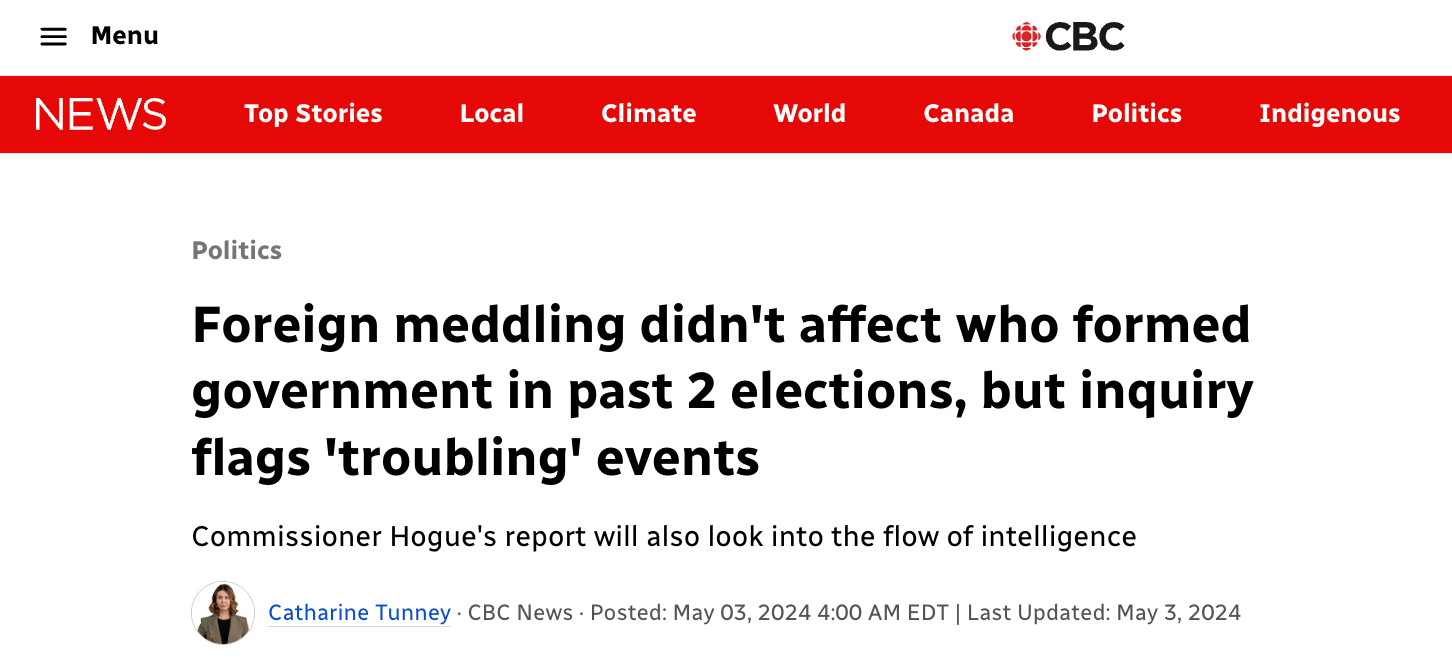
Classified intelligence documents, first reported by the Globe and Mail and later confirmed through the Public Inquiry into Foreign Interference led by Justice Marie-Josée Hogue, established that China’s Ministry of State Security and United Front Work Department ran covert operations during both the 2019 and 2021 federal elections. The operations were not subtle. Beijing deployed disinformation campaigns on Chinese-language social media platforms, arranged for international students to work on preferred candidates’ campaigns, and funnelled money through a network of proxy donors who received reimbursement for their contributions — a direct violation of the Canada Elections Act. CSIS warned the Prime Minister’s Office in 2023 that China had “clandestinely and deceptively” interfered in both elections, and internal intelligence identified a network of at least eleven federal candidates across multiple parties — seven Liberal, four Conservative — who received funding or operational support linked to CCP-affiliated organizations.
Trudeau was briefed, yet, chose not to act. When the intelligence leaks reached the press and public pressure mounted for a full inquiry, the government resisted for over a year before finally conceding. The Hogue Commission’s first report, released in May 2024, confirmed that Chinese state actors had engaged in foreign interference but concluded that the meddling had not altered which party ultimately formed government — a finding that offered just enough cover for the political class to treat the entire affair as a closed file. The final report, issued in January 2025, identified disinformation spread through social media as a major and growing threat to Canadian democracy, but by then the political conversation had moved on to leadership races and tariff wars.
What the Hogue Commission did not do — what no institution in Canada has done — is impose consequences. No candidate who received CCP-linked funding has been charged. No Liberal operative has been held accountable for ignoring the intelligence. No mechanism has been created to prevent the same interference from happening in the next election. CSIS confirmed that at least one former parliamentarian actively worked on behalf of a foreign government to influence proceedings inside Parliament itself, and even that revelation produced no criminal prosecution.
The interference extended beyond funding and disinformation into something far more direct. During the 2025 federal election campaign, Liberal MP Paul Chiang — the incumbent candidate for Markham–Unionville — stood before a Chinese-language media conference and told the room that they could claim a million-dollar bounty placed by Hong Kong authorities on Conservative candidate Joe Tay, a co-founder of HongKonger Station and a democracy advocate targeted by the CCP. “To everyone here,” Chiang said, “you can claim the one-million-dollar bounty if you bring him to Toronto’s Chinese consulate.” A sitting member of the Canadian Parliament publicly encouraged citizens to turn a political opponent over to agents of a foreign dictatorship for a cash reward. The RCMP opened a probe into whether Chiang had broken the law. Mark Carney, by then the Liberal leader, initially stood by him. Chiang issued a brief apology calling his own remarks “deplorable,” and withdrew from the race only after the RCMP investigation became public. He was not charged. He was not expelled from the party. He stepped aside quietly and the news cycle absorbed it within days.
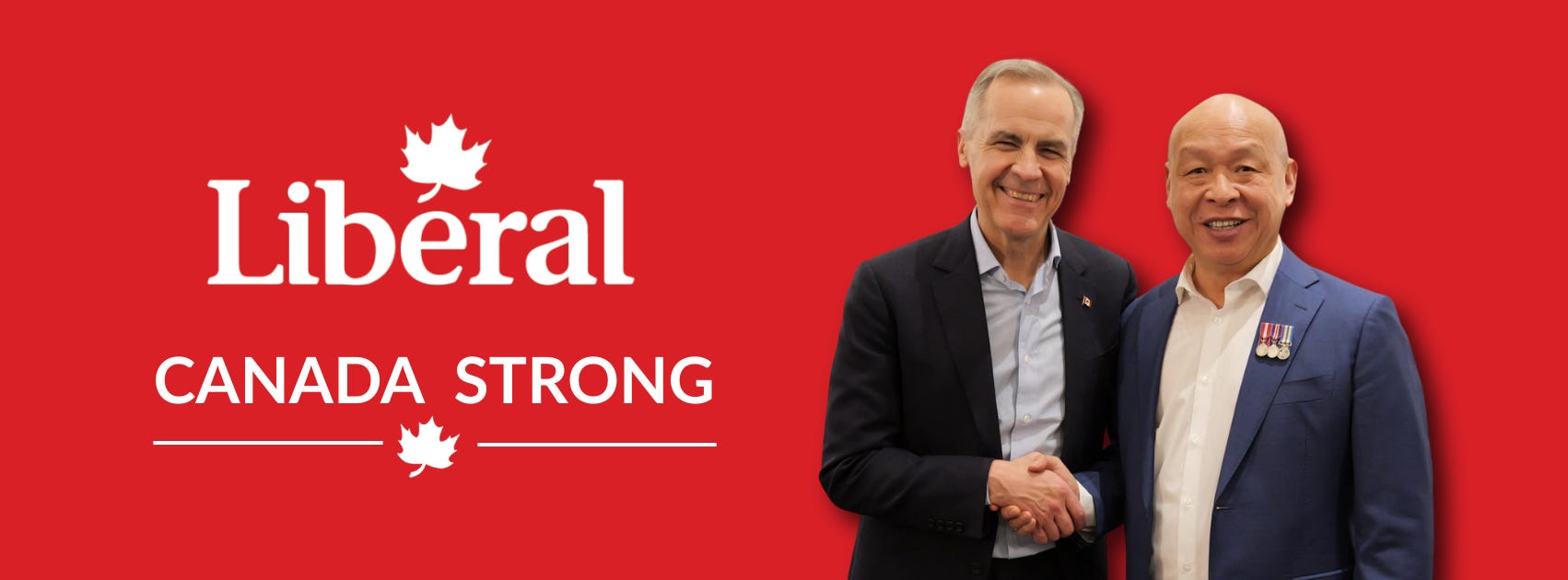
Consider the full picture. A foreign government interferes in two consecutive Canadian elections. Intelligence agencies confirm it. The Prime Minister is briefed and does nothing. A public inquiry confirms the interference but assures Canadians the outcome was unaffected. A sitting MP promotes a foreign bounty on a domestic political opponent and faces no criminal consequence. And then the new Prime Minister — the one installed after all of this — flies to Beijing within months of taking office to forge a strategic partnership with the same regime.
The word for this is not diplomacy. When a foreign power interferes in your elections, places bounties on your candidates, collaborates with scientists inside your highest-security laboratory, and your government responds by deepening the relationship, the word is capture.
The Installation of Mark Carney
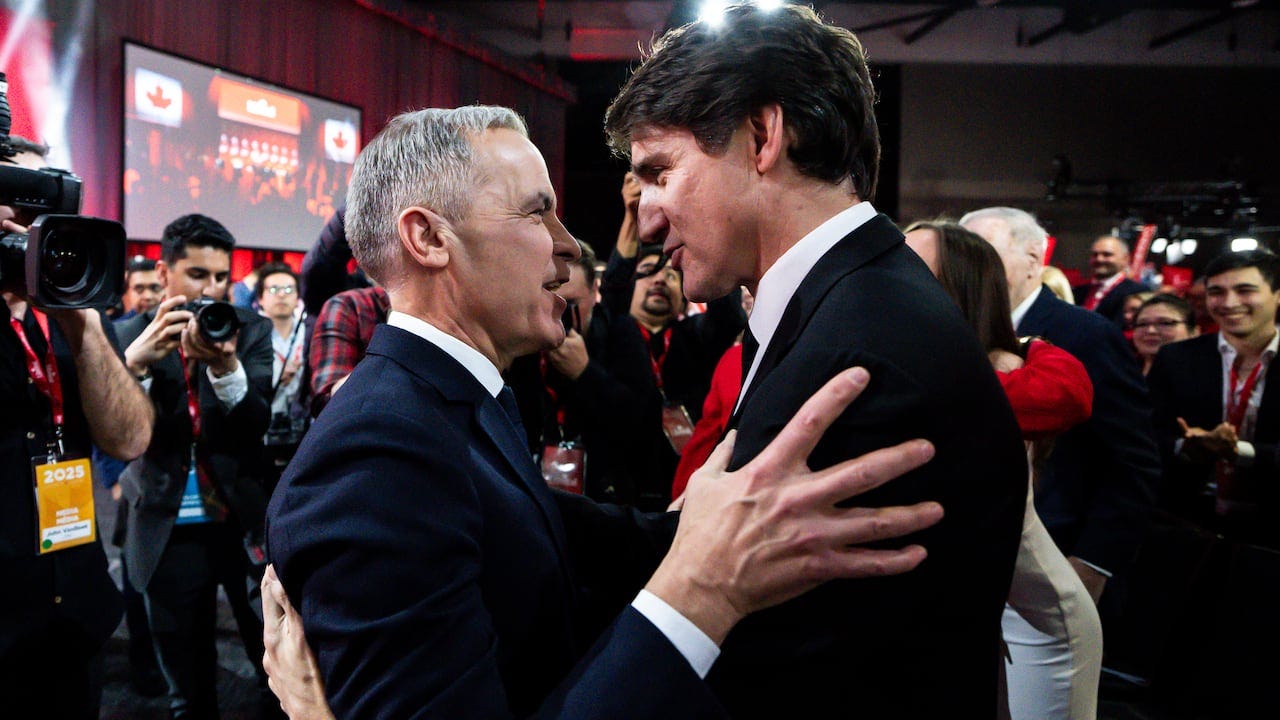
By January 2025, Justin Trudeau’s position had become untenable. His party was collapsing in the polls, his caucus was in open revolt, and a no-confidence vote was looming that his government almost certainly could not survive. The democratic resolution to this crisis was straightforward: face the confidence vote, lose, and let the Canadian public decide what came next in a general election. Trudeau chose a different path. On January 6, 2025, he prorogued Parliament — suspending the legislature entirely — and announced his resignation as Liberal leader, triggering an internal leadership race that would determine who governed the country without Canadians having any say in the matter.
The race itself was a formality. Mark Carney, the former Governor of the Bank of Canada and the Bank of England, entered as the prohibitive favourite and won on March 9, 2025, with 85.9% of the vote. The official results show that 131,674 Liberal Party members cast ballots — out of 163,836 who had registered to vote. In a country of roughly forty million people, Canada’s next Prime Minister was chosen by one-third of one percent of the population. Candidates who did not align with the party establishment were blocked from competing. The outcome was never in doubt.
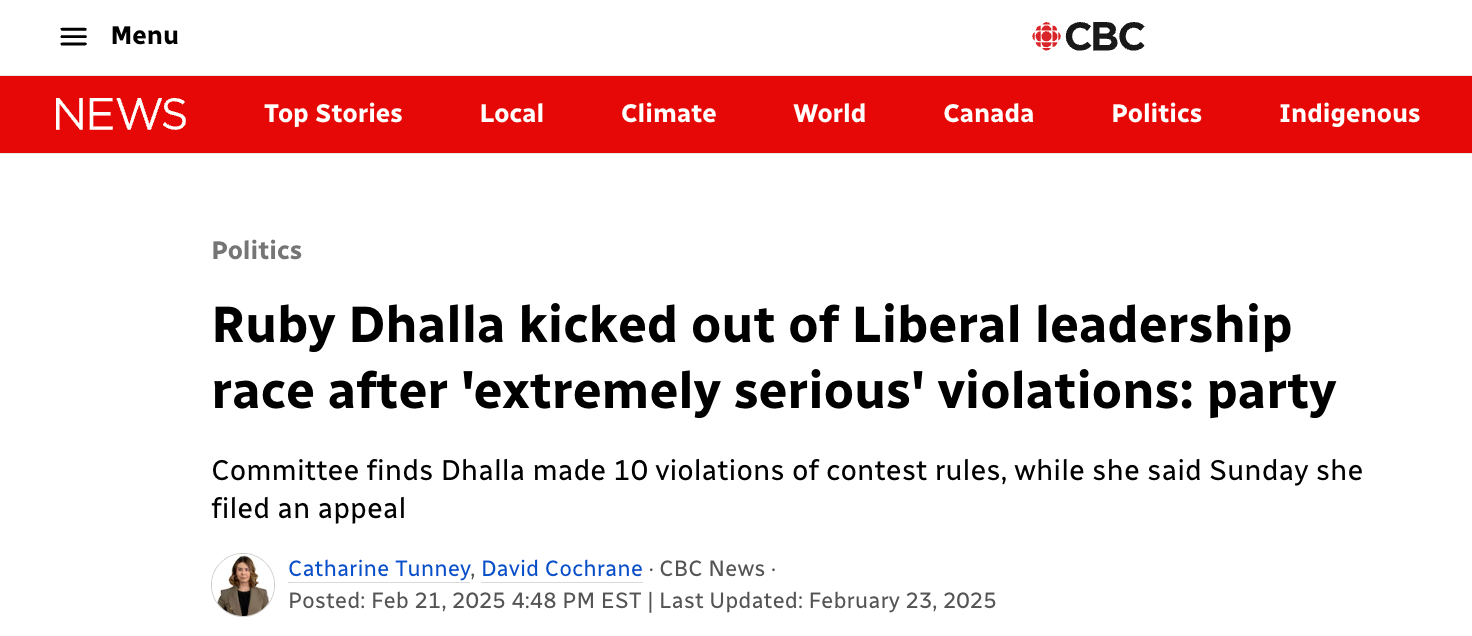
What followed was not a transition of power in any meaningful sense. Carney kept the same Trudeau-era cabinet ministers in their posts — the same faces who had presided over the Winnipeg Lab cover-up, the Green Slush Fund scandal, the parliamentary gridlock, and the refusal to act on foreign interference. The personnel did not change because the governing apparatus did not change. A new name sat at the top. Everything beneath it remained identical. Jagmeet Singh and the NDP immediately pledged to prop up the new government, ensuring that the confidence of the House — the one remaining democratic check — would not be tested.
Carney then called a general election for April 28, 2025, and won a minority government. That election is now the democratic mandate he points to. But what preceded it matters. The prorogation was not a neutral act — it was a tactical manoeuvre designed to prevent the House from expressing non-confidence in the Liberal government before a new leader could be installed and a campaign launched on favourable terms. Canadians did not choose between Trudeau’s government and the alternatives. They were presented with a rebranded version of the same government, under a new leader they had no role in selecting, running on a timeline the outgoing Prime Minister engineered specifically to avoid accountability.
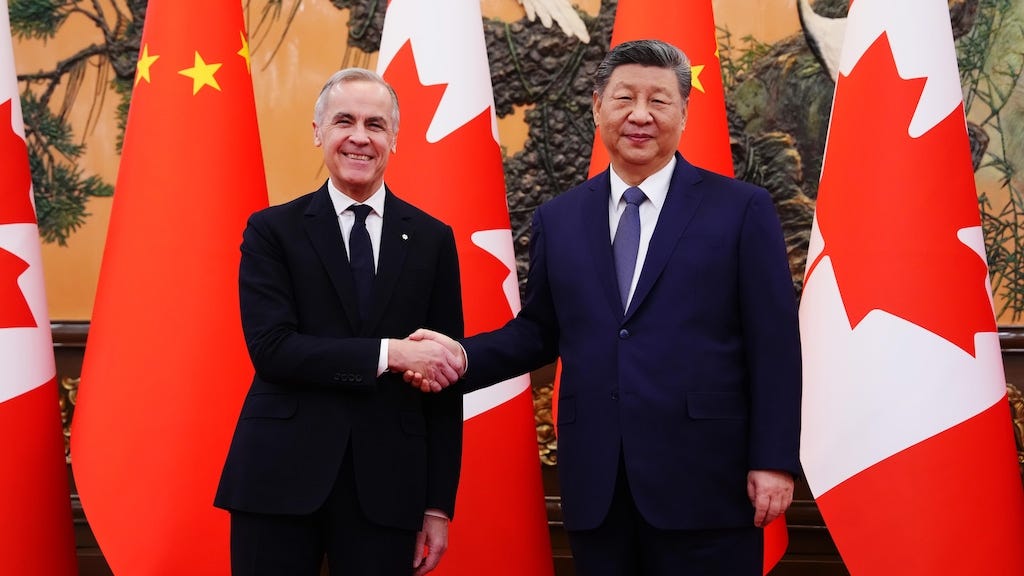
Within months of taking office, Carney made his priorities clear. In January 2026, he became the first Canadian Prime Minister to visit Beijing since 2017, announcing a new “strategic partnership” with the People’s Republic of China focused on energy, agri-food, and trade. The agreement included tariff reductions on Canadian canola and commitments to expanded agricultural exports. Finance Minister François-Philippe Champagne travelled alongside representatives of Brookfield Asset Management — Carney’s former employer, which had already invested over $3 billion in China before Carney took the helm in 2020. The Bureau documented the depth of Carney’s financial entanglement with Chinese state-linked entities during his time at Brookfield, and the East Asia Forum noted that Canada’s turn toward Beijing, while framed as trade diversification away from Trump-era tariff pressure, carried significant strategic risks that the government appeared willing to absorb.
The sequence deserves to be stated plainly. A Prime Minister prorogues Parliament to avoid a confidence vote. A leadership race selects his replacement from within the party, chosen by fewer than 132,000 people. The new leader governs with the same cabinet, propped up by the same coalition partner, and calls an election on a timeline of his own choosing. He wins a minority. And his first major foreign policy act is to deepen Canada’s relationship with the authoritarian regime that his own intelligence agency confirmed had interfered in two consecutive Canadian elections, whose military collaborated with compromised scientists inside a Canadian government lab, and whose bounty a member of his own party promoted against a Canadian political candidate.
Mark Carney was installed as Prime Minister. 131,674 Liberal members elected him to lead their party, and a minority of Canadian voters gave that party the most seats in a general election that followed. Those are not the same thing, and the distinction matters — because every decision Carney has made since taking office flows from a mandate that was engineered, not earned.
Taxation Without Representation
The phrase is older than Confederation. It was the rallying cry of the American Revolution and a foundational grievance of every democratic movement that followed — the principle that a government which taxes its citizens without granting them a functioning legislature to oversee how that money is spent has forfeited its legitimacy. In Canada, between October 2024 and May 2025, that principle was not violated in theory. It was violated in fact.

When the House of Commons ground to a halt on October 3, 2024, over the Liberals’ refusal to produce documents related to the Green Slush Fund scandal, the conventional expectation was that the standoff would resolve within days or weeks. It did not. The privilege debate consumed the remainder of the fall sitting. Christmas recess arrived with no resolution. And then, on January 6, 2025, Trudeau prorogued Parliament entirely — not to break the deadlock, but to avoid a no-confidence vote his government could not survive. The House did not reconvene until March 24, 2025, and when it did, it sat only briefly before the election was called for April 28.
According to the Library of Parliament’s own records, the House of Commons sat for just 73 days out of 455 available days between October 2024 and December 2025 — a rate of sixteen percent. For eighty-four percent of the time, Canadians had no functioning legislature. No bills were debated. No committees met. No government spending was scrutinized. No questions were asked in Question Period, because there was no Question Period to attend. The executive branch governed unimpeded by the legislative branch for the better part of a year.
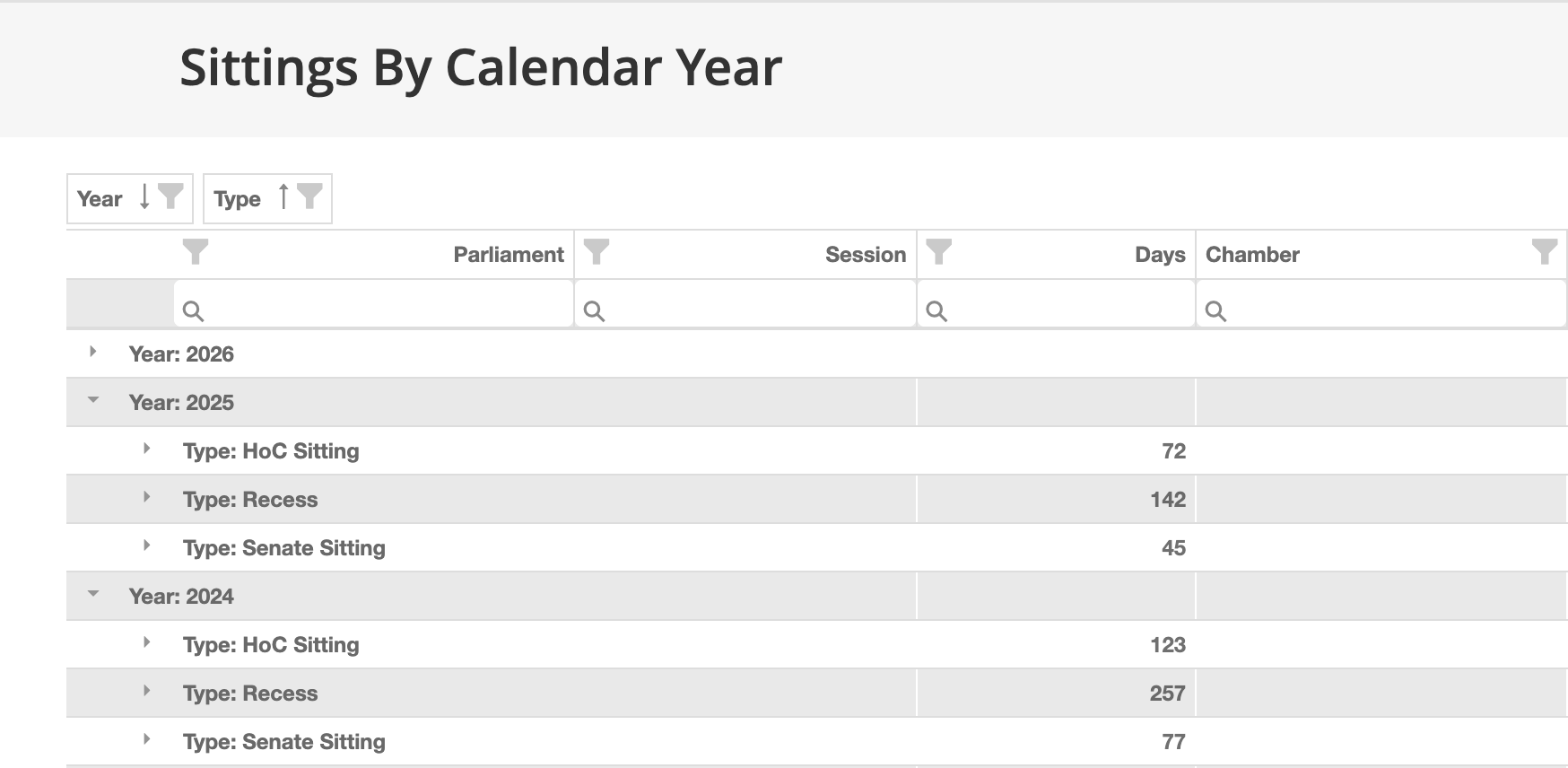
Throughout all of it, every Member of Parliament continued to collect their full salary. The base compensation for a Canadian MP is $194,600 per year, with additional allowances for housing, travel, and office expenses. Members received per diems for days they were nominally “in session” and continued to draw from taxpayer-funded budgets for constituency offices that had no parliamentary business to report on. The House of Commons sitting calendar tells the story: vast stretches of blank space where sittings should have been, interrupted by the occasional cluster of days that achieved nothing of substance before the next recess.
The cost of this arrangement was not abstract. During the months Parliament did not sit, the federal government continued to spend, regulate, and govern by Order in Council. Tax revenues continued to flow. Programs continued to disburse funds. Regulatory changes continued to be enacted. All of it happened without the oversight mechanism that exists specifically to ensure the executive does not spend public money without legislative approval. The entire premise of responsible government — the system Canada inherited from Westminster, in which the executive can only govern so long as it holds the confidence of the legislature — depends on the legislature actually sitting. When it does not, responsible government is a fiction. The government is responsible to no one.
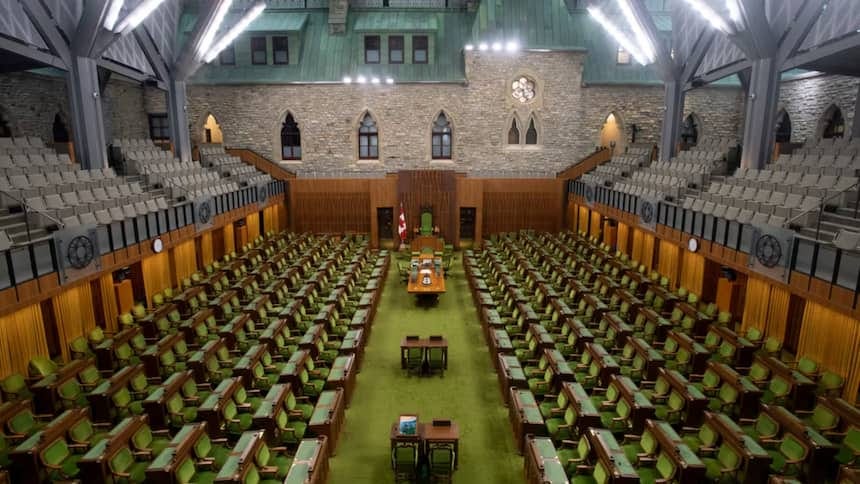
What makes this period particularly corrosive is that Parliament did not shut down because of a crisis, a natural disaster, or a national emergency. It shut down because the governing party was caught in a corruption scandal and refused to comply with a lawful order of the House. The Liberals could have produced the Green Slush Fund documents, allowed the RCMP referral to proceed, and continued governing. They chose instead to let the legislature die rather than face accountability — and then used the resulting vacuum to engineer a leadership transition, install a new Prime Minister, and call an election on their own terms.
Canadians paid for every day of it. They paid the salaries of MPs who did not sit, the operating costs of a Parliament that did not function, and the price of a government that spent their money without anyone in the room to ask where it was going. The phrase “taxation without representation” is not a metaphor in this context. For nearly eight months, it was a literal description of how Canada was governed.
Manufacturing a Majority
Mark Carney won a minority government on April 28, 2025. Six months later, he began assembling the majority the electorate refused to give him.
On November 4, 2025, Nova Scotia MP Chris d’Entremont — elected as a Conservative — crossed the floor to the Liberal caucus. On December 11, Toronto-area MP Michael Ma followed. On February 18, 2026, Edmonton MP Matt Jeneroux became the third Conservative to cross. On March 10, NDP MP Lori Idlout, representing the vast riding of Nunavut, left the NDP to join the Liberals. And on April 8, four-term Sarnia–Lambton MP Marilyn Gladu became the fifth. Five crossings in five months, each one bringing the Liberals closer to the 172 seats required for a majority. With Gladu’s defection, they sit at 171 — one seat short, with three byelections scheduled for April 13 that could deliver the rest.

In every one of these ridings, voters cast their ballots for a specific party. The residents of Sarnia–Lambton elected a Conservative. The people of Nunavut elected a New Democrat. Those voters did not choose a Liberal representative, and no one has asked them whether they accept one. The ballot they marked and the member who now claims to represent them belong to two different political parties — and under Canadian law, there is nothing they can do about it until the next general election.
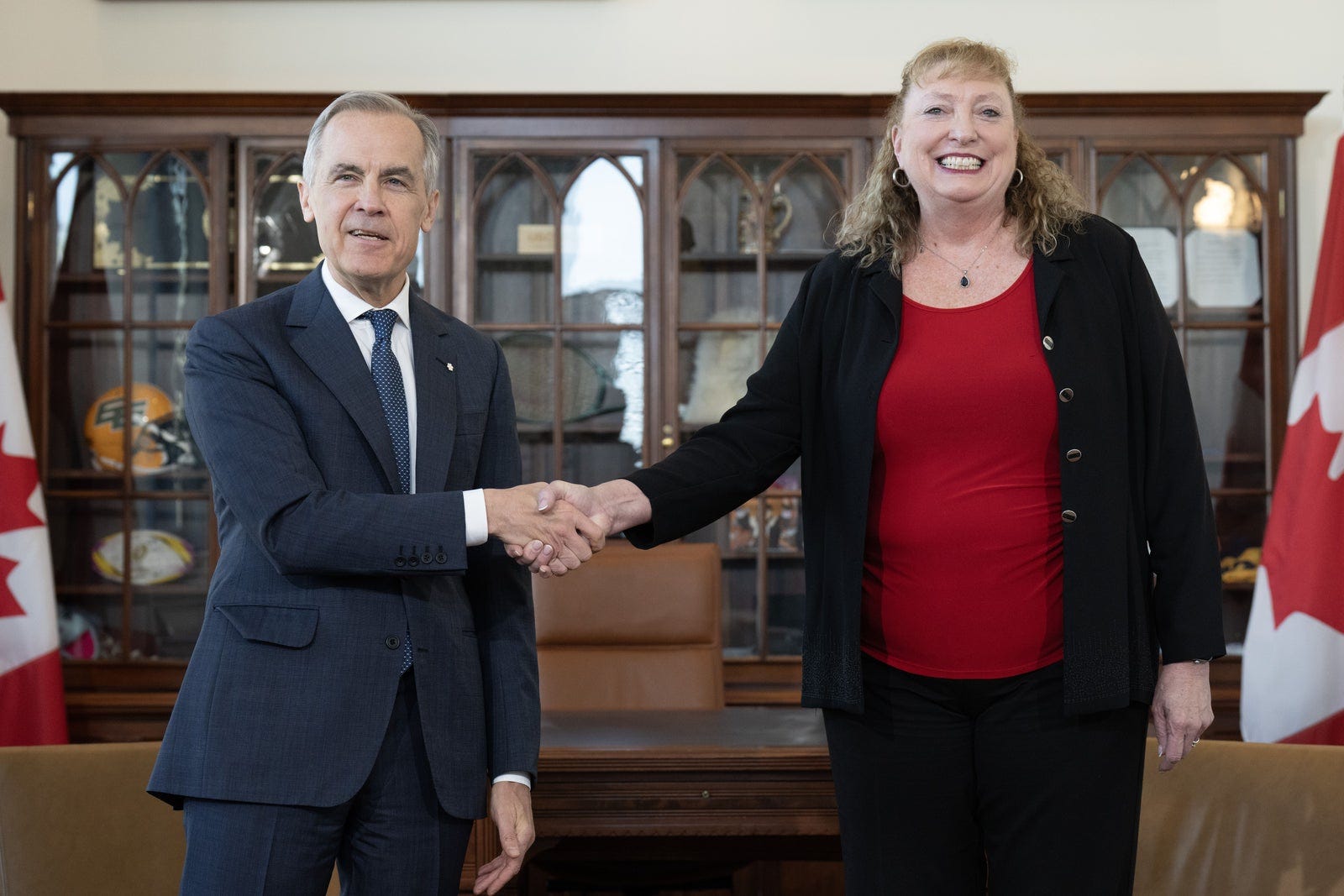
Gladu’s crossing is the most revealing. In January 2026 — three months before she herself crossed — Gladu publicly stated her position on the practice. “We elected you under this banner,” she said, “and if you don’t want to be under that banner, then we deserve a chance to have a redo.” She backed proposals that would require floor-crossing MPs to face an automatic byelection, giving voters the final say. The principle she articulated was clear and correct: the mandate belongs to the voter, not the member. By April, she had abandoned it entirely. The mayor of Sarnia and the president of the local Conservative riding association both called on her to resign and face a byelection. She has not done so. Carney has not asked her to.
The public’s view on this is not ambiguous. Angus Reid polling found that just one in four Canadians believe an MP who crosses the floor should be allowed to finish their term with the new party. Seventy-five percent believe some form of democratic accountability — a byelection, a recall mechanism, or an automatic trigger — should follow. The political class has ignored this consensus completely. There is no law requiring a byelection after a floor crossing, and no party in power has any incentive to create one, because the practice only benefits whichever party is doing the recruiting.
What makes this particular wave of crossings different from historical precedents is the arithmetic. CBC’s own analysis of floor-crossing history shows that it is rare for so many MPs to cross to the same party in such a compressed timeframe, and rarer still for those crossings to carry explicit strategic weight — each one narrowing the gap between a minority and a majority. This is not a handful of disaffected backbenchers following their conscience. This is a coordinated accumulation of seats that transforms the composition of Parliament without a single Canadian casting a vote.
The Hub framed the problem directly: Carney is “undemocratically winning a majority.” The word is precise. A majority government carries enormous power in the Westminster system — it controls the legislative agenda, dominates committees, and governs with near-impunity between elections. That power is supposed to be granted by the electorate. When it is assembled instead through backroom recruitment of individual MPs who switch their allegiance after the fact, the mandate is manufactured. The voters who created the minority Parliament on April 28, 2025, did not consent to the majority Parliament that is taking shape in April 2026.
Floor crossing is legal in Canada. It is also, in the plainest sense of the word, undemocratic. The voter chose one thing. The system delivered another. And no one with the power to change it has any reason to try.
The Husk Holds
On April 13, 2026, three federal byelections will determine whether the Carney government crosses the threshold from minority to majority. If the Liberals win even one of them (which they almost certainly will), they’ll hold 172 seats and command the House of Commons without needing the NDP, the Bloc, or anyone else. A government that was never supposed to have a majority will have obtained one through a combination of floor crossings no voter consented to and byelections triggered by the very scandals documented in this piece.
And waiting on the other side of that majority is a legislative agenda that should concern every Canadian who still believes the state answers to the citizen rather than the other way around.
Bill C-9, the Combatting Hate Act, passed third reading in the House of Commons and is now before the Senate. The bill creates new criminal offences for the “wilful promotion of hatred,” expands the definition of hate crimes, and — most critically — removes a long-standing religious-expression exemption from Section 319(3) of the Criminal Code that protected Canadians who spoke in good faith on the basis of religious texts. The exemption had never once been successfully invoked to defend hateful speech. It was removed anyway. The bill also eliminates the requirement that the Attorney General approve hate-propaganda charges before they proceed, stripping away a prosecutorial safeguard that existed specifically to prevent politically motivated charges. The Canadian Civil Liberties Association warned that the bill’s vague language could be used to criminalise peaceful protest and silence unpopular expression. The Canadian Labour Congress raised concerns about its potential to infringe on freedom of association. The Canadian Constitution Foundation called it a direct threat to the Charter right to freedom of expression.
Bill C-22, the Lawful Access Act, was tabled in March 2026 and would compel telecommunications providers to retain Canadians’ metadata for up to one year and grant police and CSIS expanded powers to access it. The bill originally appeared as part of Bill C-2, the Strong Borders Act, which was so sweeping in its surveillance provisions that the government was forced to split it into separate legislation after public backlash. Digital law professor Michael Geist warned that dangerous backdoor surveillance risks remain even in the revised version, and the government has not disclosed what the mass metadata retention regime will cost — either to taxpayers or to the telecommunications companies who will be forced to build the infrastructure.
The Online Harms Act — the previous incarnation of which died on the order paper when Trudeau prorogued Parliament — is being prepared for reintroduction. The original Bill C-63 proposed the creation of a Digital Safety Commission with regulatory power over online speech, provisions that critics including the Canadian Civil Liberties Association said amounted to government censorship of lawful content, and penalties that included the possibility of house arrest before an offence had been committed and life imprisonment for certain categories of speech.
And then there is the broader architecture of executive power that Carney has been assembling since taking office. The One Canadian Economy Act, passed in June 2025, allows Cabinet to declare any infrastructure project to be in the “national interest” — at which point all regulatory findings required under any federal law are deemed to have been made, and the Minister can issue a single document authorizing the project to proceed. The government has invoked emergency-powers rhetoric to justify everything from housing construction to trade corridors, framing routine policy priorities as crises that require bypassing normal democratic processes. And in March 2026, the Carney government asked the Supreme Court of Canada to overturn two lower-court rulings that found the invocation of the Emergencies Act during the 2022 Freedom Convoy protests was unlawful and violated the Charter. Two levels of court agreed the law was used unconstitutionally. Carney’s response was not to accept the rulings but to appeal them — seeking to establish the legal precedent that a future government can invoke emergency powers to crush a protest it finds politically inconvenient.
This is the legislative programme that a manufactured majority will be asked to pass. Criminalization of speech the government deems hateful, with fewer safeguards against abuse. Mass surveillance of Canadians’ digital metadata. A regulatory framework for online content that hands a government commission authority over what can and cannot be said on the internet. Executive power to bypass environmental and regulatory law by declaring projects to be in the national interest. And a legal campaign to establish that the Emergencies Act can be wielded against citizens who dissent.
A minority government would face opposition, amendment, and compromise on every one of these bills. A majority government faces none. With 172 seats, the Liberals control the legislative agenda, dominate every committee, and pass legislation without a single opposition vote. The bills listed above move from contentious proposals to foregone conclusions.
That is what is at stake on April 13. Not merely which party holds a few extra seats, but whether the legislative checks that remain — the last thin barriers between proposal and law — survive the week. The husk of Canadian democracy has absorbed every violation documented in this piece: elections used as escape routes, votes that went uncounted, foreign interference met with partnership rather than prosecution, a Parliament that did not sit, a Prime Minister no one elected, and a majority no one voted for. Each one was treated as an isolated incident. Each one was normalized. And each one made the next one possible.
The husk holds. It absorbs. And if the majority falls into place next week, it will have served its final purpose — providing the appearance of democratic legitimacy to a government that has spent five years systematically dismantling the substance of it.
It took a lot of energy to read this disheartening tale of woe. When will the rest of the country wake up from their slumber? The 120,000 highly skilled, educated Canadians who left last year are just the start. Will the last one leaving turn out the lights? Liberals don't know how to read anyway. They're going to just play with themselves in the dark, as Justin did
Democracy has always been a lie. A Central Bank fractional reserve ponzi scheme. Enforced through war,regime change and pedophilia.
This side good. That side bad. Fight fight fight. Government can fuck off. In all its machinations.