


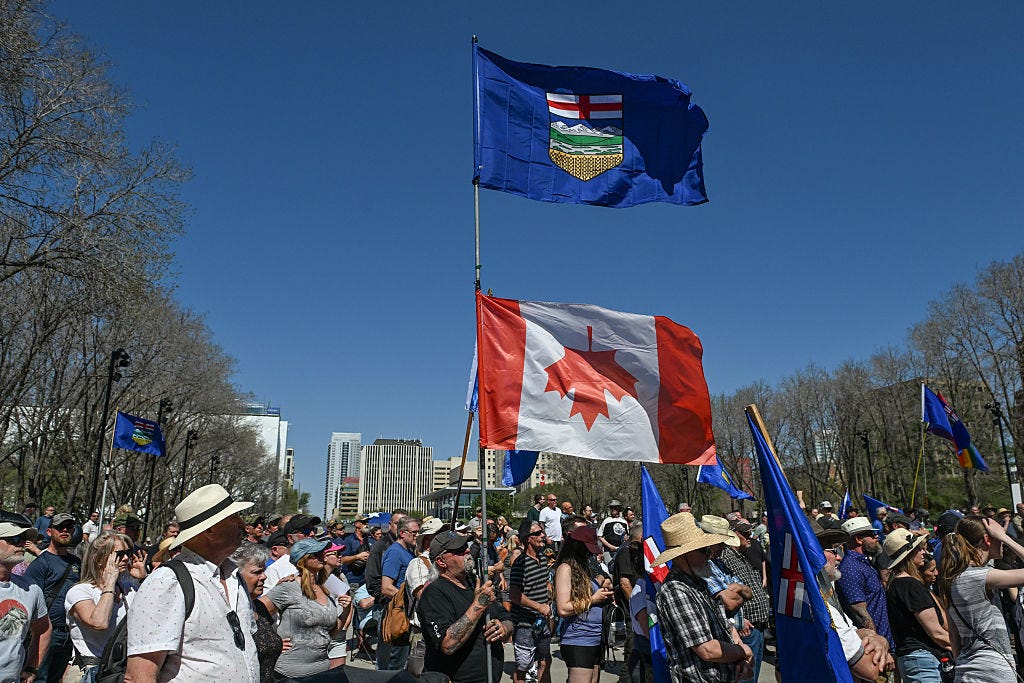
There is a growing discontent in the heart of Western Canada. Less than two weeks ago, Elections Alberta verified over two hundred and twenty thousand signatures on the petition for a vote on Alberta independence. This cleared the bar needed to trigger a vote by more than forty thousand names.
On the face of it, you’d think this a win for the separatists. Clearing the legal threshold is a first for an independence movement in Alberta. Except despite all efforts, it may change nothing.
Danielle Smith scheduled a vote for October 19, months before the petition signatures were counted. On this ballot will be ten questions, with the independence question being tenth. According to Bruce Pardy, professor of law at Queen’s University, the entire vote has been assembled to guarantee the answer comes back No.
“It’s designed to fail,” Pardy told me on a recent episode of the Blendr Report.
What They Asked For vs. What They Got
“Do you agree that the province of Alberta should cease to be a part of Canada to become an independent state?”
That was the question more than 279,000 Albertans signed a petition for, hoping to see it on an official ballot. But this is not what they will see.
Question 10 is not a yes or no. It is a choice between two options. Option 1: Alberta should remain a province of Canada. Option 2: “The Government of Alberta should commence the legal process required under the Canadian Constitution to hold a binding provincial referendum on whether or not Alberta should separate from Canada.”
The change in language makes a major difference. This will not be a vote on independence but rather, on whether to begin a process toward a second vote on independence. Even if Albertans pick Option 2, it will not put Alberta on a path out of Confederation. Just on a path to another ballot.
Jeffrey Rath, who has been pushing the Stay Free Alberta petition, is demanding Smith swap the wording. This is unlikely.
The Third Way That Doesn’t Exist
Pardy goes a step further and points to the shaky math behind it.
Let’s say you divide Alberta into rough thirds. One is committed to independence and will vote Yes no matter what the question is. Another third is opposed and will vote No no matter what. This means the decision would be made by the middle third.
While Pardy acknowledges that middle is not happy with Ottawa and would like real change, they are not yet willing to leave the country to get it.
Danielle Smith is letting that middle bloc believe there is a third way. “She has designed a referendum to tell them that,” Pardy said. “There is a third way. That is, we acknowledge that things are not right, but we are determined to change them. Here are some policy questions. And especially, here are some constitutional questions. Here’s a way to change the deal that we have right now in Confederation, because we agree with you it’s not right. So vote for these other questions. Choose the third way. If you choose the third way, we don’t actually have to go and ditch the country. We don’t have to leave the country. We can fix the country.”
Except, according to Pardy, “that third choice does not actually exist. Those constitutional amendments will not happen.”
Also on the ballot will be a Senate question. Albertans will be asked whether they support the Government of Alberta working with other willing provinces to amend the Constitution to abolish the unelected federal Senate. Not that it will be abolished. Only that Alberta should ask. Pardy admits the Senate is a problem, but amending the Constitution of Canada requires broad multi-provincial agreement — and there are provinces, along with a federal government, with no interest whatsoever in granting it.
Ballots like these serve as steam valves and it’s not the first time they’ve been used. In October 2021, Alberta held a referendum asking whether the Constitution should be amended to remove equalization — a federal transfer program that draws on general federal revenues and pays out to provinces with lower fiscal capacity, such as Quebec.
Nearly 62 percent of Albertans voted in favour of removing equalization. Hard to blame them, considering it’s been more than sixty years since the province last received a payment from it.
“And what happened?” Pardy asked. “Nothing. Because it’s not in the interests of other provinces to do that.” His indictment is clear. “Danielle is selling a bill of goods. She is acting as though the answers to these other questions matter.”
Some independence supporters propose voting only on the independence question and declining the other nine ballots, hoping to send a message. Pardy highlights the futility of this. If a third of voters do that while the other two-thirds answer everything, and the independence tally comes back negative, then they lose. “That’s a no for independence. And the fact that all the independence people voted just for that question means nothing.”
Clever ballot behaviour has little practical effect other than letting the voter feel righteous.
The Clarity Trap
Even though it’s unlikely, let’s run through the scenario that the petitioners get the question phrased their preferred way, the middle third tilts towards independence, and Option 2 wins out. Pardy argues that this still would not count.
The Supreme Court of Canada decided in 1998 that a province seeking a mandate to negotiate its departure from Confederation must put a clear question to its people and win a clear majority. Parliament then passed the Clarity Act, which created a formal process for deciding whether the question asked was truly clear.
Credit where it’s due here. Each of the ten questions sits on its own numbered, colour-coded ballot, and Question 10 is counted first at every voting station in the province. The question isn’t being buried at the bottom of a long form.
The problem is what the results say when read together. Consider Question 8, which asks whether Albertans support working with other willing provinces to amend the Constitution so that provinces can opt out of federal programs that intrude on provincial jurisdiction, such as health care, without losing any of the associated federal funding. Then there is Question 10.
Vote for both, and you have voted for two incompatible futures. Keeping federal transfers requires being a province. Independence requires not being one.
“Now you have a referendum result that you need to interpret,” Pardy said. “And if your referendum result requires interpretation, the question is not clear.”
This would hand Ottawa the proverbial trump card. Even on a win for Option 2, the federal government can say the overall result is contradictory, and decline to accept it. Even Pardy, who frequently and effectively opposes decisions made in Ottawa, said this would be “a fair argument.”
The Binding Trap
There’s another seemingly insurmountable obstacle written into Alberta statute.
In December 2025, the Alberta legislature passed Bill 14, the Justice Statutes Amendment Act. Some of what it did helped the independence side. It stripped out the provision of the Citizen Initiative Act that a judge had used weeks earlier to rule that a citizen petition could not ask an independence question at all. That ruling would have ended all hopes of separation. Bill 14 came after an earlier UCP amendment that reduced the signature threshold from roughly 350,000 names to 177,732. Without both changes this petition would never have been possible in the first place.
But Bill 14 also amended the Referendum Act, which says a government that holds a binding referendum must take the steps necessary to implement the result. Bill 14 added section 4(3), which states that if implementing a binding result would contravene sections 1 to 35.1 of the Constitution Act, 1982 — namely the Charter and Aboriginal and treaty rights — then the government is not required to implement it.
It doesn’t take a law professor to understand that Alberta independence would unavoidably remove the application of the Canadian Charter of Rights and Freedoms, as well as the section 35 guarantee of Aboriginal and treaty rights within Alberta.
Pardy argues that “the government has given itself the power to refuse to implement independence even if the vote is yes.”
If that wasn’t enough, the result of Question 10 isn’t even binding. Whatever Albertans choose in October, no government is obliged to act on it.
To recap: The ballot is built to produce a No. If it somehow goes the other way, Ottawa can call the result contradictory. And if for some unforeseeable reason they don’t, Edmonton is under no obligation to do anything about it.