


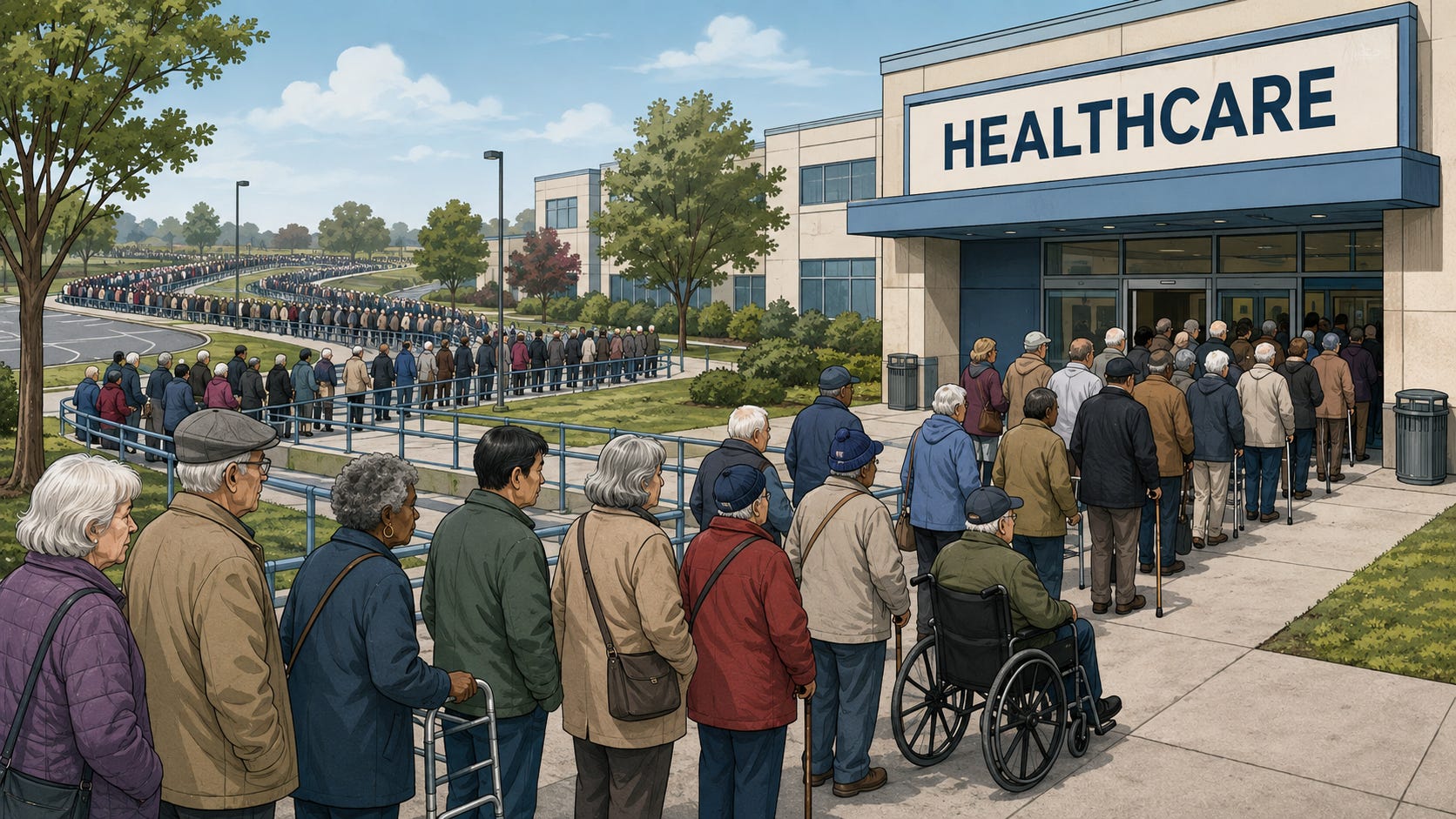
Many Canadians may be operating under what economists call fiscal illusion—the tendency to underestimate the cost of government when taxes, borrowing and public spending are difficult to connect.
A related idea from behavioural economics is called payment decoupling. It describes what happens when the act of buying something is separated from the moment you actually feel the money leaving your hands.
Researchers call that feeling the “pain of paying.” The less visible and immediate a payment is, the less psychologically noticeable it can become.
Cash is a good example. You take money out of your wallet, count it, hand it to the cashier, and physically see that you have less left. Tapping your phone or credit card makes the transaction faster and less visible. You still pay the same amount, but the loss may not feel as immediate.
Something similar can happen with government spending.
Income and payroll taxes are normally deducted automatically before workers receive their pay. Canadians can see those deductions on their pay stubs, but they may not feel like separate transactions. Sales taxes appear on receipts, but many people focus on the final price rather than how much tax they paid.
This has the effect of separating the taxes people pay from the government programs those taxes fund. We contribute through numerous different taxes and then receive public services without being given an individual bill showing exactly how much we paid for each one.
A recent Fraser Institute study estimated how much Canadian families in different income groups contribute toward public healthcare through the tax system.
Canadians often describe the country as having “free healthcare” because insured hospital and physician services generally have no charge at the point of use, but that does not mean healthcare is free. It means the bill is largely paid collectively through taxation.
According to the Canadian Institute for Health Information, total healthcare spending in Canada was projected to reach approximately $399 billion in 2025—about 12.7% of the country’s GDP. Roughly $261 billion of that amount was expected to come from public funding.
Healthcare is therefore not free. It is one of the largest expenses funded by Canadian governments. The real question is whether Canadians understand how much they personally contribute—and whether they believe the services they receive are worth that price.
What we pay
Now that we’ve established that healthcare is definitely not free, we should also establish how much each of us roughly pays per person.
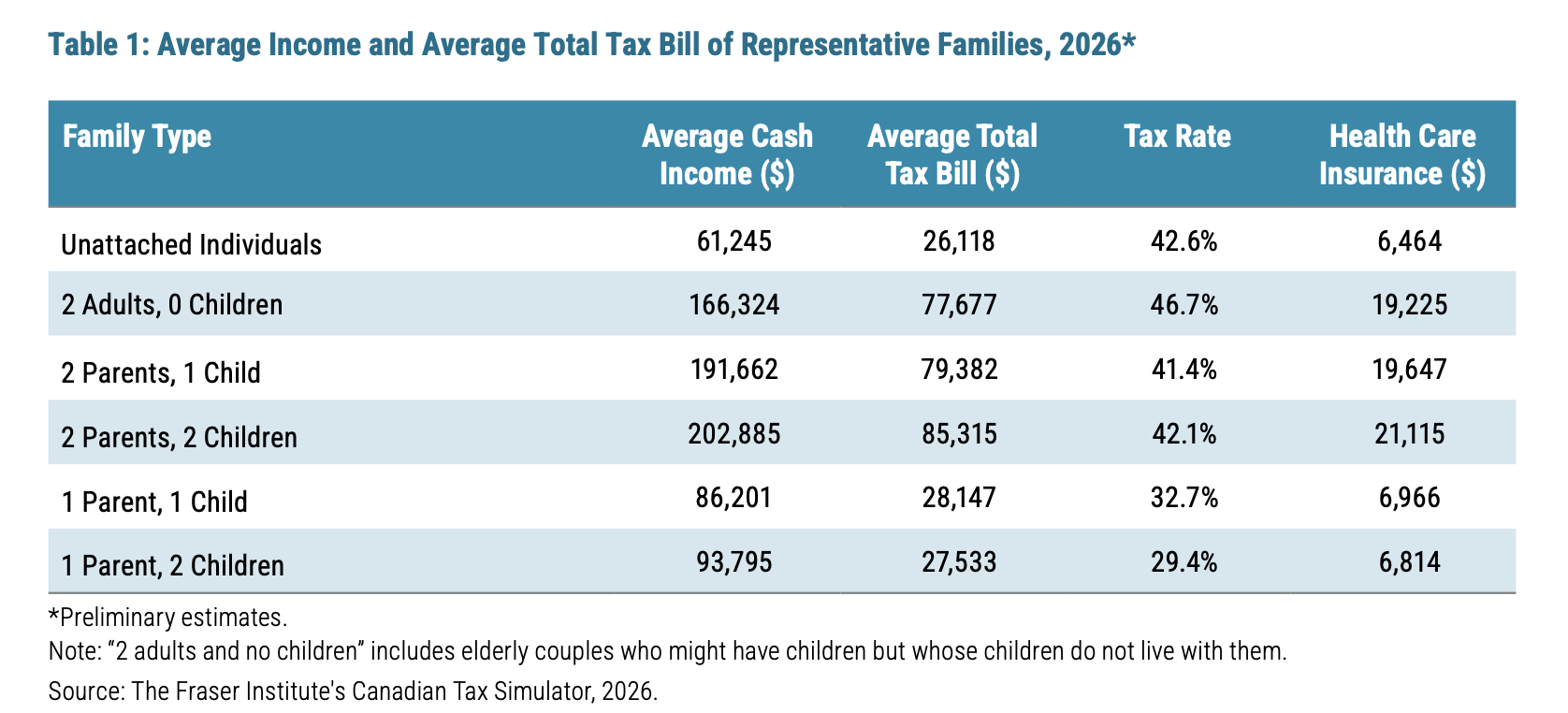
The study estimates that Canadian families, depending on the type, pay between $6,464 and $21,115 annually.
Adults living alone pay about $6,500/year, adults with 1 or 2 children pay around $7,000/year, and households with 2 adults and 0-2 children pay around $20,000/year.
So not only is healthcare not free, but the adults in 2 adult households pay about $10,000 each to healthcare with an income of $166,000-$202,000/year, coming out to about 10% of their income.
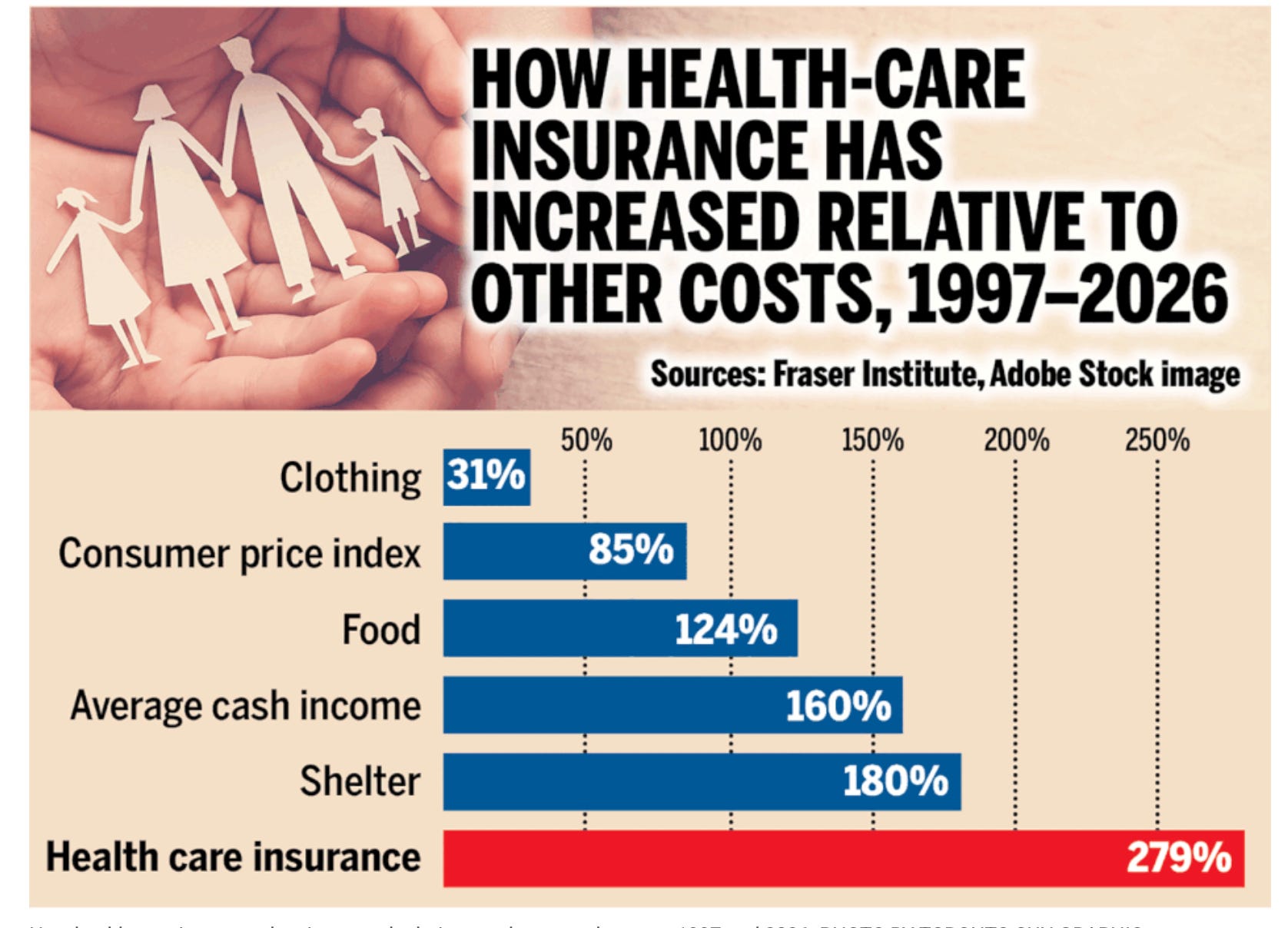
It’s also important to note that the cost of healthcare has gone up exponentially compared to other goods.
From 1997 to 2026, the cost of clothing has gone up by 31%, the consumer price index went up by 85%, food increased by 124%, the cost of shelter increased by 180%, and public health care insurance went up by a staggering 279%. Not to mention the average income has only gone up by 160%.
In other words, public healthcare costs have grown 2.3 times faster than food, 1.5 times faster than housing, and 1.7 times faster than the average income.
Unfortunately, the bad news continues. According to Stats Canada, an estimated 24.7% of tax revenues will be spent on healthcare alone. In only the last 10 years the average Canadian family has been paying 47.1% more for healthcare, while incomes have only risen 46.2%.
The Middle Class Trap
As always, it seems being in the middle is the worst place you can be in the economy. Let me explain. When you look at how much families with different income levels contribute to the healthcare system, you see that the people getting the worst deal are the middle class.
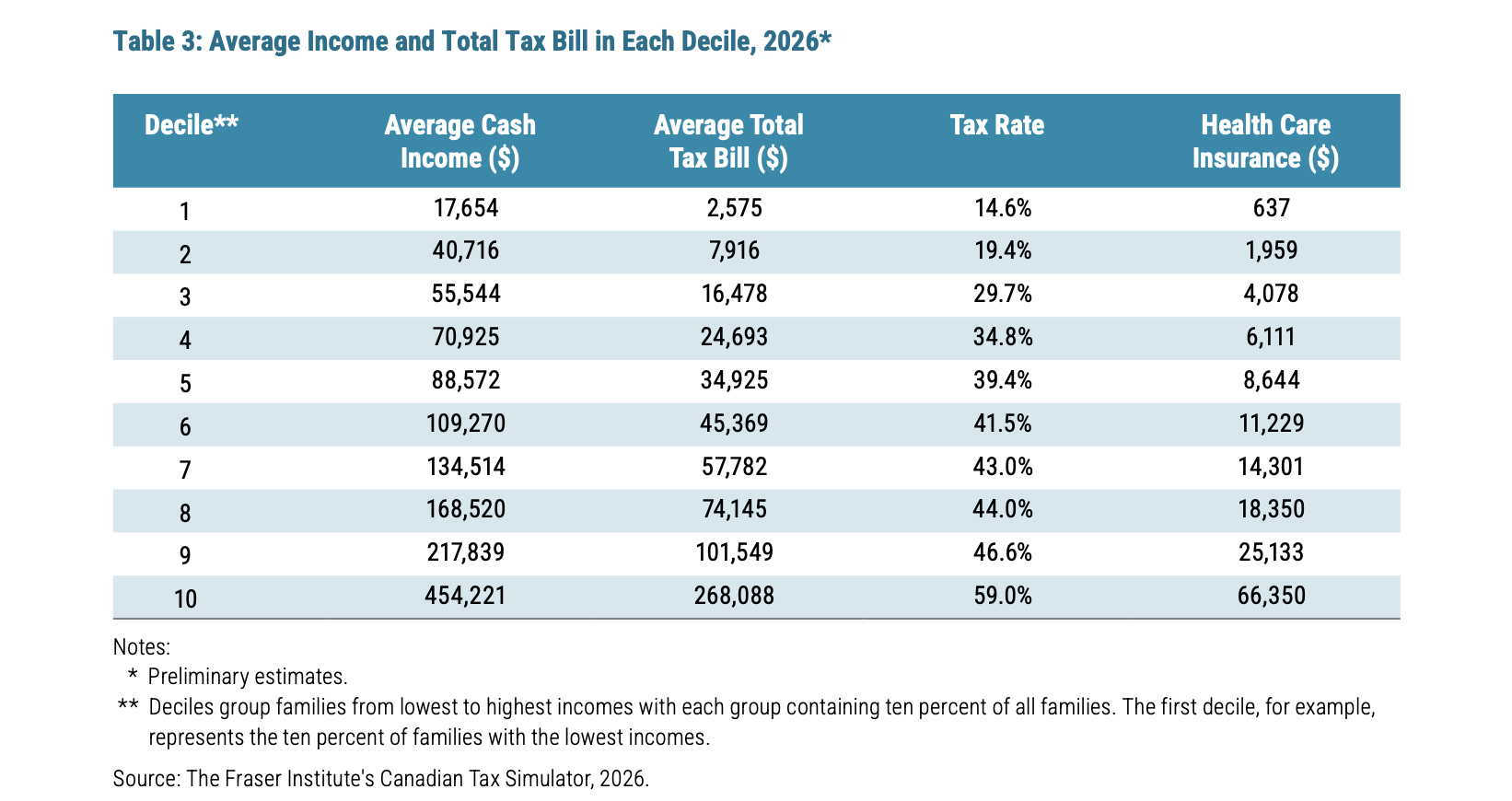
The 10% of Canadian families with the lowest incomes will pay an estimated average of just $637 toward public healthcare in 2026. Families in the middle-income group will pay about $8,644, while families in the top 10% will pay around $66,350.
At first, that might seem like exactly how a progressive tax system should work. If you make more, you pay more, but once you do the math, you can see where middle-income families start feeling the squeeze.
The lowest-income families earn an average of $17,654, while the middle-income group earns $88,572—roughly five times as much. However, the middle-income group pays more than 13 times as much toward healthcare.
Now compare the middle with the top. The highest-income families earn an average of $454,221—just over five times the income of the middle group, but they pay about 7.7 times as much toward healthcare.
Put another way, the lowest-income families pay about 3.6% of their income toward public healthcare. Middle-income families pay about 9.8%, while the highest-income families pay 14.6%.
That means the burden jumps by roughly 6.2 percentage points between the lowest and middle-income groups. From the middle to the top, it rises by only another 4.8 points.
The top 10% still pay the largest share of their income overall, so it would not be accurate to say middle-income families pay the most, but these numbers do suggest that middle-income families face the steepest increase in the burden.
That raises a fair question: Are middle-income Canadian families getting squeezed the hardest by the way public healthcare is funded?
What we get
So, now we know how much Canadians pay for healthcare; naturally the next question is, what do we get compared to how much we pay? Well, it doesn’t look good.
According to a report by Second Street, about 3.7 million Canadians are waiting for surgeries, diagnostic scans, or specialist appointments, although incomplete provincial data suggests the true number could be closer to 5.8 million.
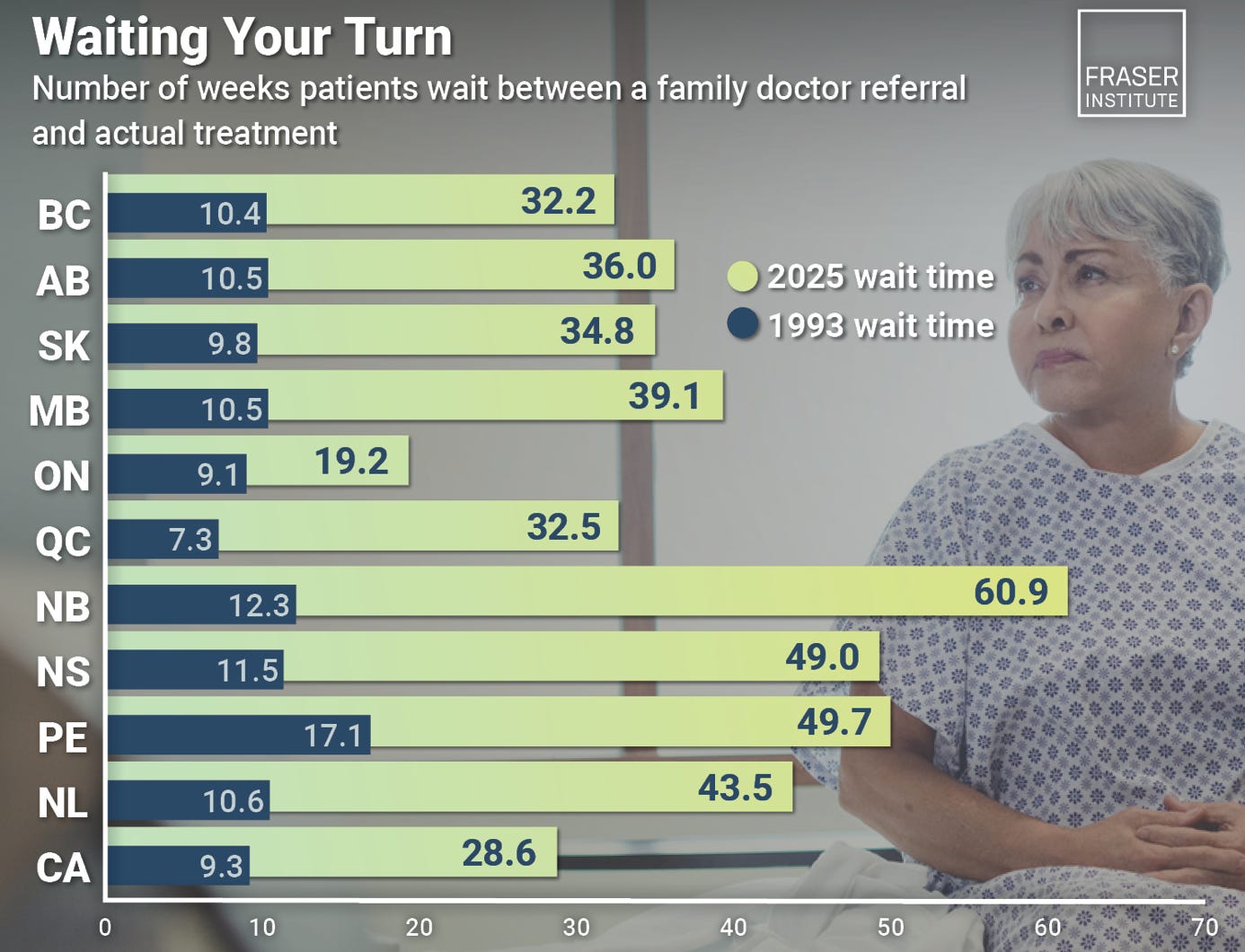
According to another study by the Fraser Institute titled “Wait Your Turn: Wait Times for Healthcare in Canada”, Canadians have to wait 28.6 weeks on average to see a specialist. With wait times being the lowest in Ontario at 19.2 weeks and highest in New Brunswick at 60.9 weeks.
Compared to Canadians only having to wait 9.3 weeks in 1993 and paying 279% more since 1997, Canadians are not getting a better deal with the added cost.
Many Canadians also struggle to find a family doctor. A national study done in 2022 found that 1 in 5 Canadians, or 6.5 million Canadians, don’t have a family doctor.
Unfortunately, even considering all of the provided information, many Canadians will still resist being skeptical of the situation our country’s healthcare system is in. There is a wide sentiment among Canadians that “free healthcare” is a part of our very identity. It’s become almost sacred and untouchable no matter how objectively bad it gets.
Many will blame the sharp increase in immigration for the increase of the cost of healthcare, but there is little data to support that. Seniors aged 65 plus account for 47% of health care spending, which is a trend that is slowly increasing.
Others will say that being taxed any amount is a small price to pay for the relief of not getting a bill at the end of treatment. Although that never takes into account the risk of never getting care in the first place due to long wait times.
Canadians will have to ask themselves if clinging to the illusion of free health care is worth the cost of a very deadly reality.
There's a Dutch saying that translates to something like this: "Only the sun comes up for nothing." Canadians are more and more living delusional lives. Our democracy is on the skids on a parallel course with our economy. Alberta and perhaps Quebec will vote to leave this mess. Carnage is all talk and no action. His climate ideology and TDS are turning Canada rapidly into third-world status. What made Canada great is hard work, hard work, hard work, and absolute minimum government interference. Alberta will try to reestablish that template, and perhaps Quebec will follow or lead. Ottawa is killing Canada.
It's a dangerous and divided world, but Canadians are not seeing the Real Danger is the man that keeps on saying those words. Forget TDS, Canadians need to forget about him, have a look at our Top Dog? Who is stirring the real division in our Country, I find it absolutely appalling. I'm not sure we will make it with the markets betting against us with Billions, money leaving our country to green projects in far off lands, Alberta talking separation, we need a Trade Deal with the USA, but that seems to be the last thing on Prime Minister Carney's mind. His mind is certainly not on the citizens of this country. His mind is on his Investments at Brookfield, headquartered now in the USA. He is using our money and has been since he started "ADVISING" Trudeau with the crazy policies that were put in place and are still in place to benefit his interests. Follow the Money, as they say? Follow our money. Go back to before he became Prime Minister. It's criminal, I can't believe what's happening. Read the other day that the fines for conflict of interest charges to Parliamentarians is 500$. It's a joke. Thanks Blendr for you reporting, and truth.