


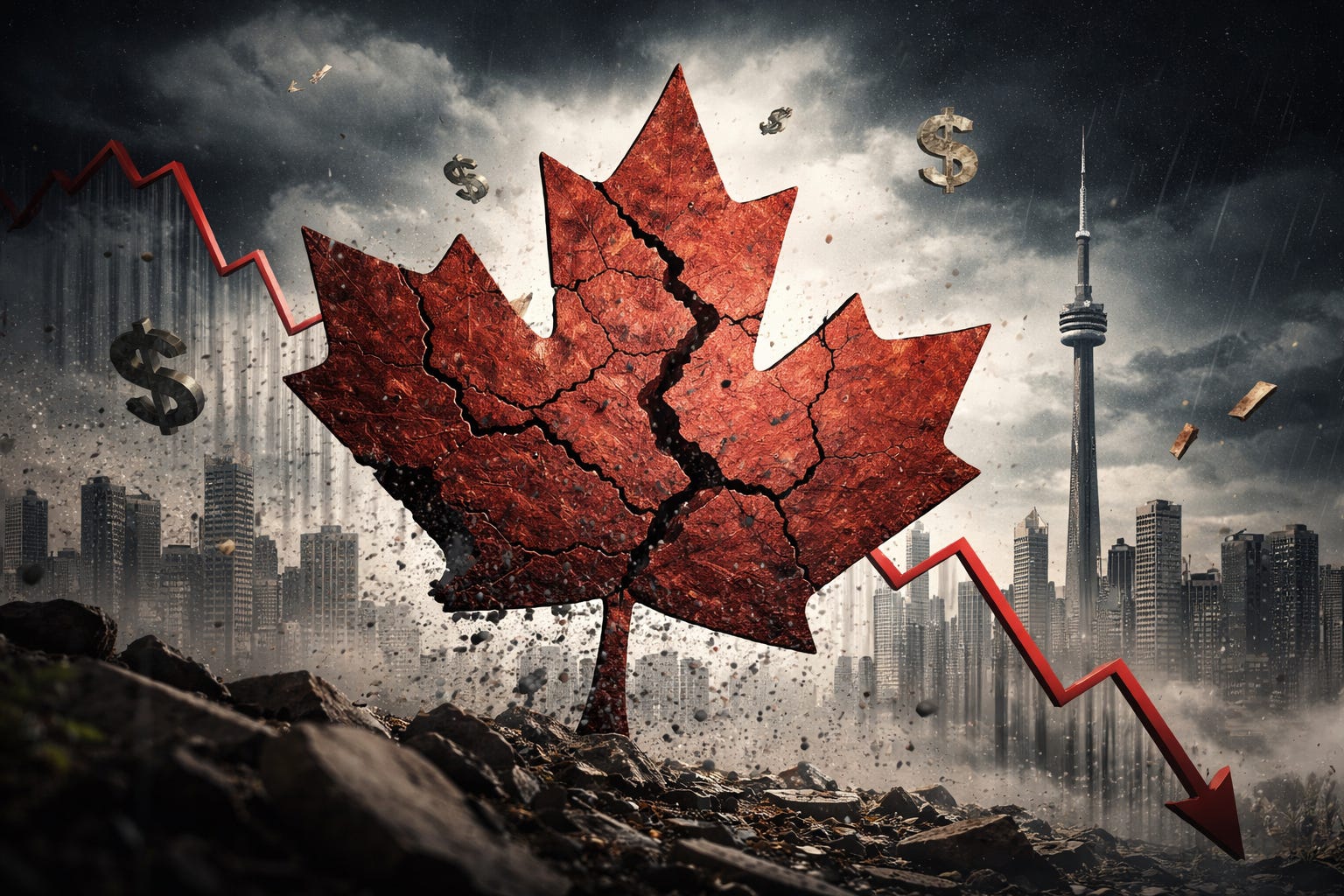
As Canada moves through the opening months of 2026, the country finds itself confronting an economic reality it has long tried to postpone, reframe, or deny. What was once dismissed as cyclical softness now looks unmistakably structural. What was once blamed on temporary shocks now appears to be the cumulative result of years—arguably decades—of policy failure, institutional complacency, and economic self-deception.
Stagflation has returned. Unemployment is rising. Productivity has stalled. Household debt has reached historic extremes. Entire sectors are quietly collapsing. Public finances are stretched to the breaking point. And externally, the economic order Canada built its prosperity upon—unfettered access to the U.S. market under a stable continental trade regime—is suddenly in question.
The warning signs are no longer theoretical. They are visible in labour force data, GDP releases, insolvency filings, housing renewals, shuttered storefronts, and now, geopolitics. The recent dismissal of the USMCA by U.S. President Donald Trump, coupled with Prime Minister Mark Carney’s abrupt courtship of Beijing, marks a dangerous inflection point: Canada is being squeezed simultaneously by its own internal fragilities and by a rapidly hardening external environment.
What follows is not a single shock, but a chronological unraveling—a slow-motion economic failure driven by policy choices that prioritized expansion without productivity, spending without restraint, and growth without resilience.
The Long Gestation of Decline
Stagflation, Productivity Collapse, and Structural Fragility (Pre-2025)
Canada’s present crisis did not arrive suddenly. It was incubated.
The post-pandemic recovery of the early 2020s was widely hailed as a triumph of government intervention. Massive fiscal stimulus, emergency programs, and public-sector expansion prevented immediate collapse. But the recovery that followed was profoundly uneven—and ultimately hollow.
Federal spending surged. The public sector expanded dramatically. Deficits became normalized. Yet living standards failed to recover meaningfully. Real wages stagnated. Productivity growth slowed to a crawl. Inflation embedded itself into the economy not as a brief spike, but as a persistent condition.

By the mid-2020s, Canada had drifted into what economists cautiously called “stagflation lite”: weak growth paired with stubborn inflation. Interest rate hikes by the Bank of Canada—necessary to contain price pressures—further suppressed investment and consumption. Businesses delayed capital spending. Consumers leaned increasingly on credit. The economy remained technically afloat, but only because it had not yet been tested.
This pattern is historically familiar. Canada experienced similar dynamics in the 1970s, when inflation, energy shocks, and weak productivity combined to erode real incomes for years. More ominously, early warning signs echo the preconditions of deeper historical downturns: prolonged misallocation of capital, overdependence on a narrow export base, and a state that grows faster than the economy that must sustain it.
Nowhere is this clearer than in productivity. Canadian labour productivity has been effectively stagnant for more than a decade. Real output per hour worked remains barely above 2017 levels. Business investment per worker continues to lag the United States by a widening margin, particularly in machinery, technology, and advanced manufacturing.
Productivity is not an abstract metric. It is the engine of wage growth, competitiveness, and fiscal sustainability. Roughly 80 percent of long-term economic growth comes from productivity gains. Canada has largely forfeited that engine—and no amount of redistribution or stimulus can substitute for it.
The Cracks Become Fractures
Labour Market Deterioration, GDP Contraction, and Household Fragility (Late 2025)
By late 2025, the consequences of these structural weaknesses began surfacing in headline data.
Unemployment climbed to 6.8 percent in December 2025, a level historically associated with the onset of broader economic downturns. This increase was not driven by a sudden collapse, but by a more insidious dynamic: population and labour force growth outpacing job creation, combined with outright losses in manufacturing, construction, and services.
Underemployment rose. Hours worked declined. Confidence eroded.
At the same time, GDP contracted by 0.3 percent in October 2025—the sharpest monthly drop in nearly three years. Manufacturing was hit hardest, particularly machinery and wood products, sectors already weakened by new U.S. tariffs and declining global demand. Construction slowed. Resource extraction softened. Even services—normally Canada’s shock absorber—showed strain amid strikes and reduced discretionary spending.
While November showed tentative stabilization, the broader trend was unmistakable: momentum had stalled. With interest rates held steady to contain inflation, policymakers found themselves trapped—unable to stimulate without risking renewed price pressures, yet unwilling to accept contraction.
This paralysis was mirrored in fiscal policy. Promised reductions in public-sector headcounts were quietly scaled back from 10 percent down to just 5 percent. Temporary spending became permanent. Deficits widened not because of crisis response, but because restraint proved politically impossible.
Meanwhile, Canadian households—already among the most indebted in the world—reached a breaking point.

Household credit market debt exceeded $3 trillion. The debt-to-disposable-income ratio approached 175 percent, the highest in the G7. Mortgages alone accounted for three-quarters of that burden. And with more than a million mortgages set to renew in 2026 at significantly higher rates, payment shocks of 15 to 20 percent became unavoidable.
This is not merely a housing story. It is a macroeconomic vulnerability. When households are this leveraged, even modest increases in unemployment or interest rates can cascade into reduced spending, rising delinquencies, and financial instability. By late 2025, surveys suggested that more than 40 percent of Canadians were within a few hundred dollars of insolvency.
