


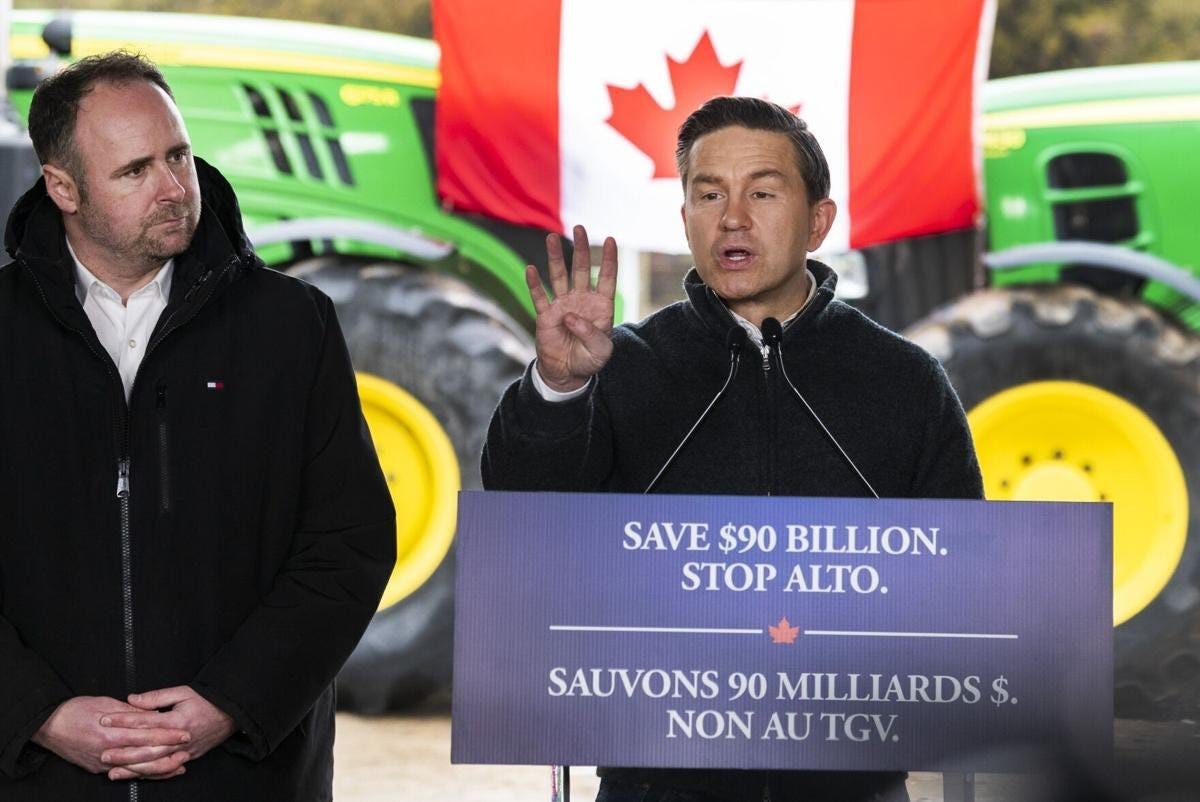
Pierre Poilievre opposing the $90 billion Liberal high-speed rail project has caused quite the controversy. And if you look at who’s screaming the loudest, the reason becomes obvious pretty fast.
The Laurentian Elite who loot Canadian taxpayers stand to gain BILLIONS from this project. They want major backlash against anyone who threatens their impending goldmine of corruption. The media, the consulting class, the construction lobby, the politically connected firms who always seem to end up with the contracts, need you to believe this is about trains…
BUT IT’S NOT ABOUT TRAINS.
So let’s do the math they don’t want you to see.
The Base Cost
The sticker price is $90 billion. That’s what the Liberals want you to hear. But that number is a fantasy before the first shovel hits dirt.
According to Joe Carson’s Diagnosis Red Tape, for every dollar paid in federal taxes, 26.72% never re-enters the private economy. It’s consumed by bureaucracy. Not fraud or corruption. Just the ordinary cost of government machinery processing money through its own bloated system.
That means a $90B public project carries roughly $24B in administrative overhead baked in from day one. The true taxpayer burden before anything goes wrong: ~$114B.
There are roughly 20 million taxpayers in Canada. That’s ~$5,700 per taxpayer.
All so that 12 million people in the Toronto-Ottawa-Montreal corridor can have access to rail.
Already a hard sell. But here’s the problem….
THINGS NEVER GO ACCORDING TO PLAN!
Bent Flyvbjerg is an Oxford professor who has assembled one of the largest megaproject database in the world: 16,000+ projects across 136 countries going back to 1910. His findings are disheartening to say the least.
91.5% of megaprojects go over budget, over schedule, or both. The mean cost overrun is 62%. And less than 1% of megaprojects are completed on time, on budget, and deliver the benefits promised.
One percent.
According to long time friends of the Liberal Party, McKinsey & Company, rail projects specifically go over budget by an average of 44.7%, and their demand is overestimated by 51.4%.
Applied to Alto: $114B × 1.447 = ~$165B. That’s ~$8,250 per taxpayer.
Meanwhile, the Liberals’ projected $35B yearly GDP increase?
If demand is overestimated by half, which is exactly what the data says happens, that’s closer to $17B.
Remember that number because it will become important later.
The Eglinton Precedent
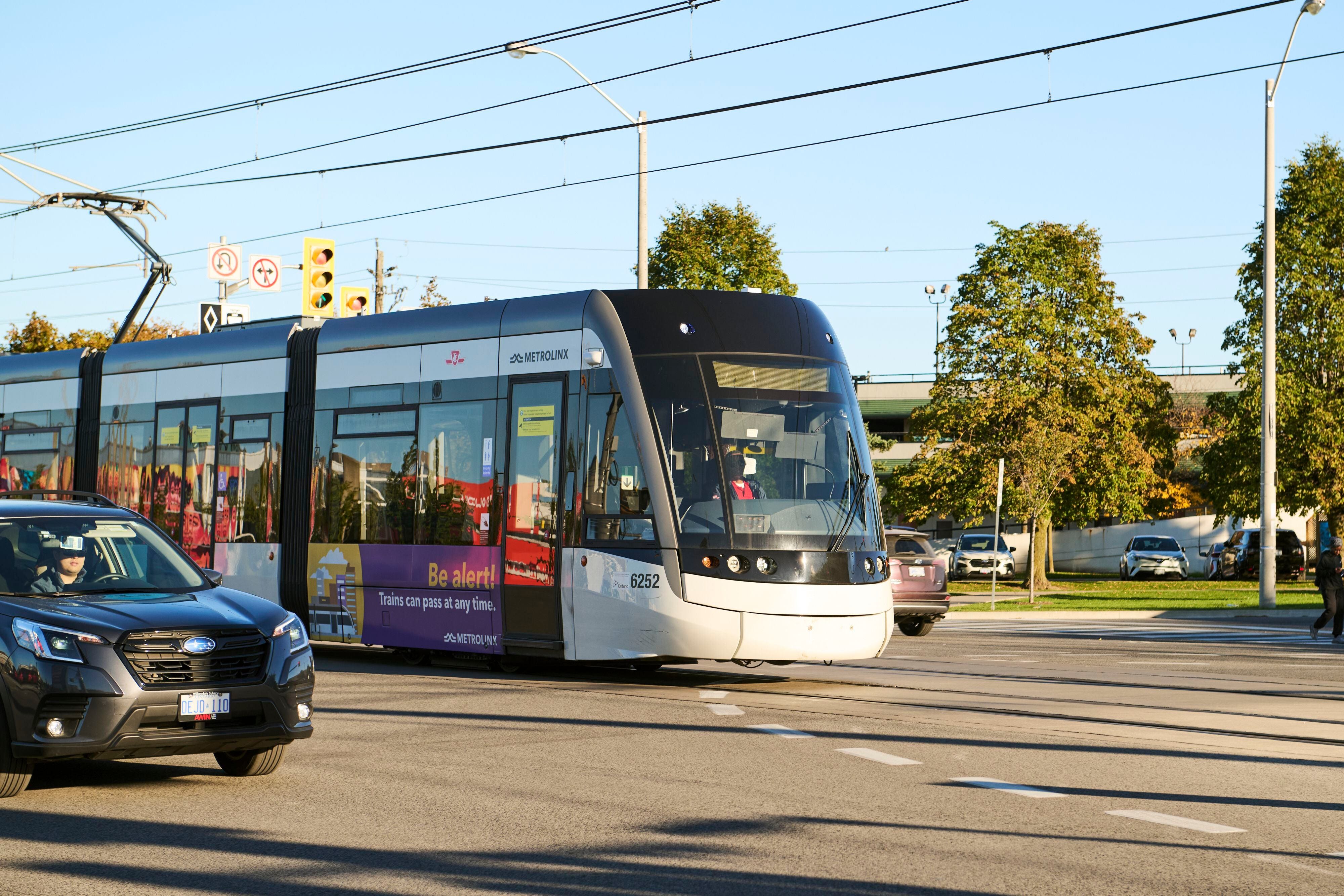
You don’t need to look at Oxford databases or McKinsey reports to understand what’s coming. You just need to look at Toronto.
The Eglinton Crosstown LRT was originally projected at ~$5B.
Final cost: $13B.
It took 15 years of construction.
Businesses along the corridor were destroyed.
Communities were wrecked by noise, dust, and road closures for over a decade.
This isn’t conjecture—I lived on Eglinton for five years during the construction. I saw it firsthand, and I even worked for a business that went under because of it.
Premier Doug Ford refused to hold an inquiry and nobody was held accountable.
The Eglinton Crosstown is 19km long. Alto is ~1,000km. That’s 53 times longer.
The Eglinton Crosstown cost $684M per kilometre. If Alto hit a similar per-km cost, you’d be looking at $684B. That’s obviously absurd — but the directional point is devastating. Canada just proved, in real time, in its largest city, that it cannot build 19km of light rail on time or on budget. The proposed answer is to build 1,000km of high-speed rail?
The Eglinton’s cost multiplied by 2.6×. Apply that same factor to Alto: $114B × 2.6 = ~$296B.
That’s ~$14,800 per taxpayer.
Now Add Corruption

Everything above assumes the money is merely wasted through incompetence. But Canada has a well-documented history of something worse.
The Charbonneau Commission (a provincial inquiry that ran from 2011 to 2015) established that mafia-linked cartels inflated Montreal public contract prices by up to 30%. A retired government whistleblower told the Globe and Mail in 2009 that the Mafia controlled roughly 80% of road contracts in the Montreal region, with prices inflated up to 35%. Economists estimated that up to $500 million was misappropriated in Montreal alone between 2004 and 2009.
And it hasn’t stopped. As recently as 2024, the top five firms captured 76% of infrastructure contract value in the sector, with estimated overcosts of at least $40 million in a single year — approximately 20% above fair market price.
Then there’s the “Green Slush Fund” scandal. The Auditor General found 186 conflicts of interest at Sustainable Development Technology Canada, with an estimated $150-390M in misappropriated funds. That’s roughly 17-45% of the fund’s total approvals funnelled to insiders. Board members were approving grants to each other’s companies. The bonus structure incentivised rapid disbursement without oversight. When Conservatives demanded documents, the Liberals shut down Parliament rather than hand them over.
Applied to Alto’s $90B base: $15-40B in corruption.
Applied to the Eglinton-style $296B scenario: $50-133B in corruption.
BUT IT GETS WORSE
Everything above treats this project as though the government has $90 billion sitting in a vault. It doesn’t because Canada is running deficits.
That means THIS PROJECT WILL BE FINANCED WITH DEBT.
And debt has interest…
The Canada 30-year government bond yield currently sits at ~4%. That’s the rate taxpayers will be charged to borrow money over decades to finance this project.
Here’s what nobody in Ottawa wants you to think about: interest compounds during the entire construction period BEFORE A SINGLE DOLLAR OF GDP BENEFIT IS GENERATED. Every year, the government borrows billions more to keep building. Every year, interest piles onto the previous years’ borrowing. By the time the last rail is laid, the total debt is already far larger than the sticker price.
Alto’s own timeline projects full completion by 2043 — roughly 15 years of construction. Let’s run those numbers for each scenario.
