


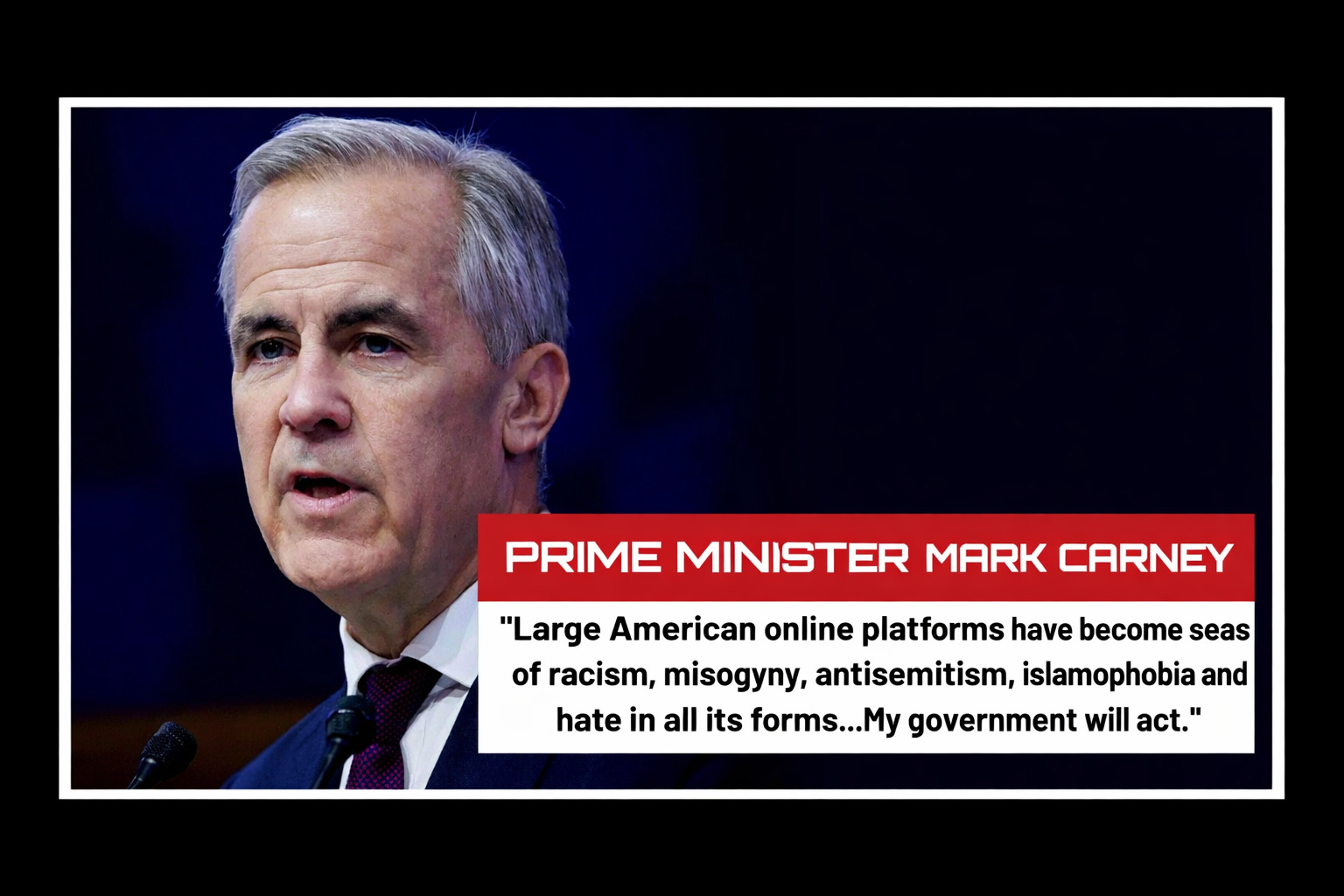
When Mark Carney entered Canadian politics after a career spanning Goldman Sachs, the Bank of Canada, and the Bank of England, he did not arrive as a retail politician. He arrived as an institutional figure—a steward of systems, a manager of crises, a man accustomed to steering complex structures through turbulence.
His supporters saw steadiness. His critics saw something else: a governing philosophy shaped in elite, transnational circles where stability is engineered from the top down.
Now, as Prime Minister, Carney has turned his attention to what he describes as one of the most pressing threats facing modern democracies: the influence of large social media platforms.
In public forums and interviews, Carney has argued that “large American online platforms have become breeding grounds for racism, misogyny, antisemitism, Islamophobia, and hate in all its forms,” adding that his government “will take action.” Framed in this way, the policy objective appears uncontroversial. Few Canadians would defend criminal incitement or harassment. Few would deny that digital platforms have amplified extreme rhetoric.
But the question facing the country is not whether online harms exist. It is how far a government should go in defining, regulating, and ultimately controlling the boundaries of acceptable speech.
Beneath the language of protection lies a far more consequential transformation: the gradual repositioning of the federal government from regulator of industries to architect of the national information environment itself—asserting the authority to define what constitutes harm, and constructing the legal machinery to enforce that definition.
The Language of Protection and the Language of Power
Carney’s phrasing is precise. By emphasizing “large American platforms,” he reframes the issue not merely as one of moderation but of sovereignty. By his definition, these companies are not simply negligent corporations; they are foreign actors shaping Canadian civic life.
That framing echoes themes he has articulated beyond media policy. At the World Economic Forum in Davos in early 2026, Carney warned of a “rupture” in the global order, a “new world order,” and urged middle powers like Canada to assert greater “strategic autonomy.” Though those remarks centred on trade tensions and geopolitical fragmentation, the through-line was clear: in periods of disorder, authority must consolidate.
Applied to digital governance, that instinct translates into national reclamation of informational space. Regulation becomes an assertion of control over the arteries through which public opinion flows.
Carney’s rhetoric intensified during renewed friction with Trump, a moment when skepticism toward American corporate power resonated domestically. In an era where Meta, X, Google, and YouTube shape what billions see and share, Carney’s government argues that Canada must assert regulatory control to protect democratic integrity. But sovereignty over platforms inevitably intersects with sovereignty over speech.

When the state disciplines infrastructure providers, it also reshapes the incentives governing which ideas survive within that infrastructure. This is where skepticism becomes unavoidable.
Digital platforms have not merely amplified hate; they have also exposed government failures, mobilized grassroots protest movements, and disrupted entrenched power structures. The trucker protests, pipeline battles, and decentralized online campaigns demonstrated that information no longer flows exclusively through legacy institutions.
For governments accustomed to message discipline, that decentralization is destabilizing. Regulation, then, can serve two purposes at once: addressing genuine harms—but far more importantly for the governing power structure—restoring predictability to an unruly public square.
From Economic Management to Information Management
Carney’s career was built on the management of financial systems under stress. During the 2008 financial crisis and Brexit-era volatility, intervention was not ideological — it was operational. Stability justified coordination.
That managerial worldview now appears to be extending beyond markets and into discourse itself.
The governing assumption seems to be this: left unregulated, complex systems produce risk. Risk must be mitigated through centralized oversight. The logic that once applied to liquidity and capital flows is now being applied to speech and information.
The shift is subtle but consequential. Canada is moving from regulating industries to shaping the informational environment in which democratic debate unfolds. The difference is enormous.
The Legislative Framework: A Converging Architecture
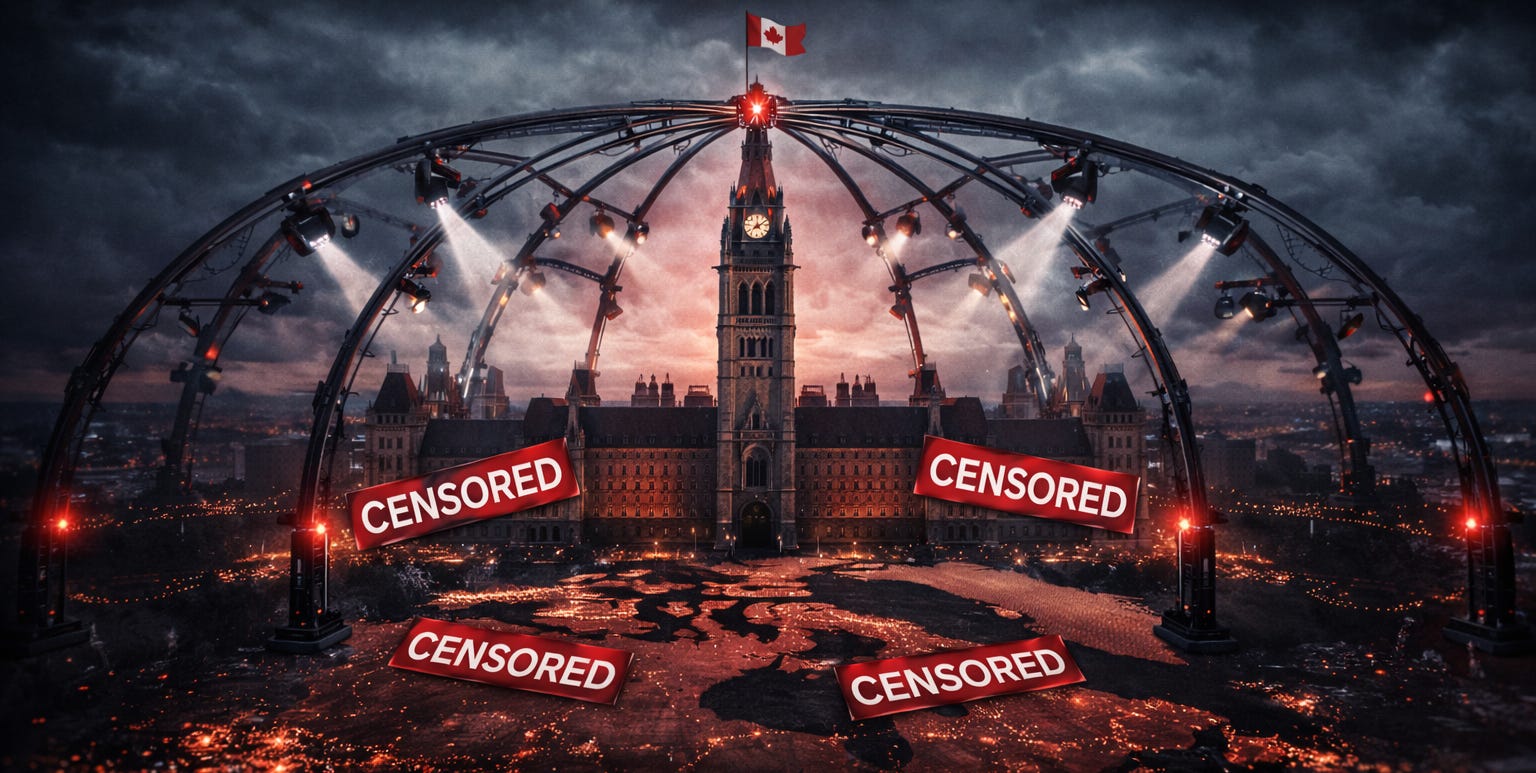
Several pieces of legislation—some inherited from prior Liberal initiatives, others introduced or revived under Carney—form a developing architecture of digital oversight (and control).
The Online Harms Act (Bill C-63)
Marketed as a response to child exploitation and severe online abuse, the Online Harms Act establishes a Digital Safety Commission with authority to investigate platforms and impose penalties reaching up to 6 percent of global revenue. The law outlines categories of harmful content and creates a complaint-based enforcement structure.
Bill C-63 does not stop at regulating platforms; it also establishes a sweeping penalty framework for individual Canadians. The bill will enforce fines reaching as high as $75,000, pre-emptive restrictions aimed at individuals deemed likely to commit an infraction, retroactive consequences for past expression, and in the most severe cases, the possibility of life imprisonment for speech-related offences.
The intention, supporters argue, is to bring accountability to companies that have too often relied on reactive moderation. However, the concern lies in scope and elasticity. Definitions of “harmful content” can, and will, evolve over time. Regulatory bodies, once empowered, tend to interpret mandates expansively—especially when public pressure mounts following high-profile incidents.
In practice, this dynamic incentivizes platforms to over-censor. When the penalty for failing to remove harmful content is severe, but the penalty for removing lawful speech is minimal, risk-averse companies err on the side of deletion.
The result may not be overt government censorship in the beginning. It may be algorithmic narrowing—an environment where controversial debates on immigration levels, gender policy, energy development, or public spending quietly disappear from visibility because they sit too close to regulatory red lines.
Bill C-9 and the Expansion of Hate Provisions
The government’s amendments to hate-related provisions in the Criminal Code seek to streamline prosecutions and broaden the interpretation of hatred. Proponents contend that modern digital environments require updated tools to address coordinated harassment and extremist symbolism.
The tension emerges in the boundary between incitement and offence.
Canadian law has long distinguished between speech that is deeply offensive and speech that meets the high legal threshold for criminal hate propaganda. Lowering procedural barriers and widening definitions risks compressing that distinction, and suppressing dissent of any kind.
Legal scholars have repeatedly noted that criminal law must be precise, particularly when it intersects with expression protected under the Charter. Vague or subjective criteria will create uncertainty, and uncertainty chills speech even before a single conviction occurs, but perhaps that’s the entire point.
Cybersecurity and Surveillance Authorities
Through Bill C-8, the federal government has expanded oversight powers related to cybersecurity and critical digital infrastructure. In an era of foreign interference and ransomware attacks, the case for enhanced defensive capabilities is clear.
Yet the line between cybersecurity coordination and data access is thin—in fact, it’s non-existent. Mandated reporting requirements, inspection authorities, and information-sharing frameworks will increase state visibility into all digital systems. Even if rarely abused, the capacity itself alters the balance of power between citizen and state.
The long-term concern is not that Canada will become a surveillance state overnight. It is that the technical capacity for comprehensive monitoring, once normalized, becomes politically difficult to unwind. The concern, then, is that Canada will become a surveillance state incrementally—expanding oversight inch by inch, step by step until the cumulative shift is recognized only after the balance has already tilted. And, as we know, governments rarely relinquish power once acquired.
Information Control Through Economic Levers
The Online News Act (Bill C-18), introduced before Carney’s premiership but still emblematic of the broader trend, forced digital platforms to negotiate compensation with Canadian news organizations. The immediate result included news blockades and a restructuring of how journalism circulates online.
While designed to sustain domestic media—which is nonsense to begin with—critics argue it strengthened legacy outlets while disadvantaging smaller independent voices. Economic pressure, rather than explicit censorship, reshaped visibility.
When combined with digital harms legislation, economic regulation and content moderation begin to converge. Platforms must not only comply with payment schemes but also align with content standards defined by government-appointed bodies.
Over time, this convergence creates an informational ecosystem in which state policy and platform policy reinforce one another.
The Cultural Consequences
Legal authority is only one dimension of power. Cultural adaptation often follows regulatory change.
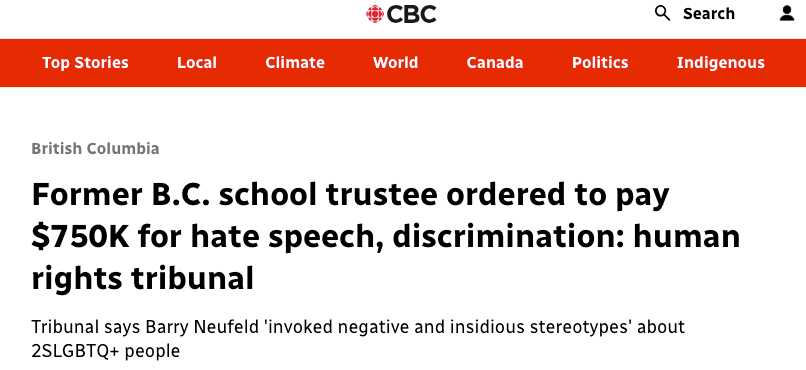
If digital expression becomes increasingly policed—whether by state agencies or by platforms responding to regulatory threat—institutions adapt. Universities recalibrate acceptable discourse. Corporate HR policies mirror federal language. Media outlets narrow guest lists to avoid reputational or regulatory exposure. Once these powers are entrenched, it would take only a few actions by the legal system to suppress dissent, setting the stage for a new, tightly controlled order to take hold. If you’re wondering where we’re at in this cycle, all you have to do is read yesterday’s news - Former B.C. school trustee ordered to pay $750K for hate speech, discrimination.
Citizens quickly grasp cause and effect, and even if they disagree with the rules, they begin to internalize boundaries and weigh the risks of crossing them. The effect is rarely dramatic—instead, the margins of debate contract incrementally, and topics once contested become socially untouchable. The public square becomes managed not through overt censorship but through layered incentives.
Over time, the country drifts toward a form of managed democracy—one in which elections remain competitive, but the informational environment surrounding them is curated, stabilized, and sanitized. In other words, true democracy is left behind.
A National Turning Point
Canada is not Russia, nor is it China (yet), but trajectory matters.
Liberal democracies do not lose freedoms abruptly. They erode gradually, through expansions of authority responding to genuine problems. Each crisis—misinformation, hate speech, foreign interference—expands the justification for oversight. Each oversight becomes institutionalized. Each institution develops incentives to justify its continued existence.
Carney presents his approach as modernization, as responsible governance in a networked age. And it is true that digital platforms have introduced new challenges to the world. Yet the remedy carries risk of its own.
When governments define the outer boundary of acceptable thought, political temptation is inevitable. Today’s definition of harm can expand tomorrow. Today’s protection can become tomorrow’s enforcement.
The core question is not whether online abuse should be addressed. It is whether Canadians are comfortable concentrating informational authority in institutions that are themselves political actors—institutions that benefit from censoring criticism, and punishing dissent.
Once the oversight architecture is fully established, with empowered commissions, standardized penalties, and institutionalized monitoring frameworks, rolling it back becomes extraordinarily difficult..
So…Canada stands at a crossroads not between order and chaos, but between competing visions of democratic resilience: one that tolerates friction and risk in exchange for wide latitude of expression, and another that prioritizes stability, even if that stability narrows the range of permissible dissent, and enforces harsh penalties for stepping out of line.
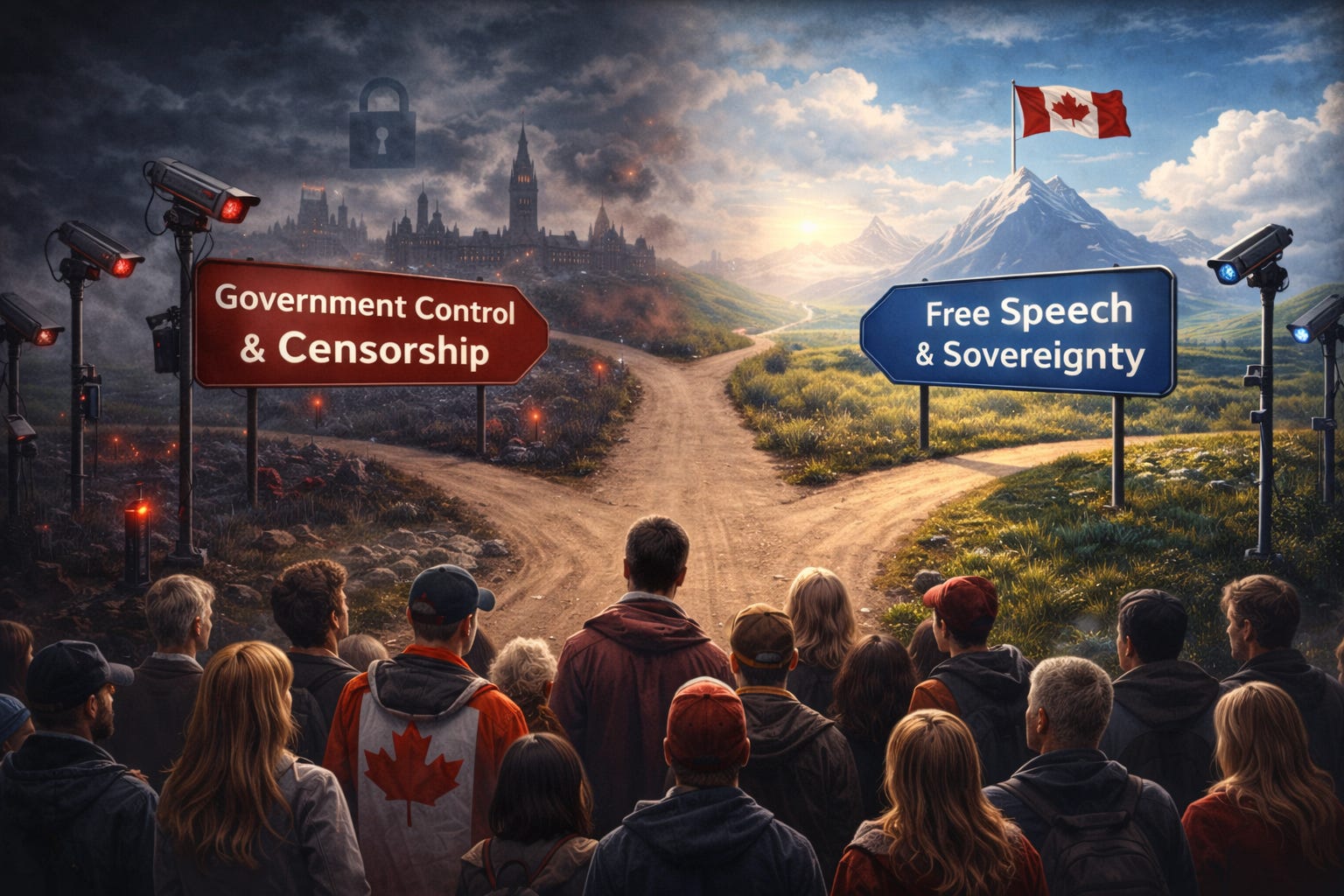
Mark Carney has made his choice clear. The country must now decide whether it agrees.
Thank you for the time you invest in educating people.
I have to say I’m not optimistic. I pray for Canadians to wake up. But fear the punishment witnessed and experienced by citizens at the convoy has stunted the resolve to stand up. Stay strong folks.
Do you watch Mike Benz? Apparently the US is opening a freedom portal in Europe to help Europeans get around censorship laws. The US is trying to keep free speech alive because this is a global issue. The technocrats have lost the public with mass migration and refusing to honor the voters desires. Carney is following in Europe’s footsteps. Thank you for bringing awareness to this issue.