


Good morning, it’s Tuesday, December 15th. In today’s news, young Canadians have become the least happy generation, Canada’s homelessness crisis is accelerating, Poilievre responds to Michael Ma’s floor crossing, the FBI arrested 4 individuals plotting multiple terror attacks in California, and much more.
First time reading the daily blend? Sign up here.

Why Young Canadians Have Become the Least Happy Generation

New data from the World Happiness Report reveals that young Canadians are now the least happy age group in the country. As recently as 2011, Canadians under 30 sat at the top of the happiness ladder. Today, they’ve fallen below middle-aged adults — a stark shift from the well-being curve that once looked U-shaped. That long-standing pattern, where youth and age bookended a slump in midlife, has collapsed. For young people, satisfaction has dropped faster than in almost every other country included in the study. Only four countries — Jordan, Venezuela, Lebanon and Afghanistan — saw a steeper fall.
This isn’t about mood swings. It reflects deep structural shifts that shape how young people live, work and plan for the future. Chief among these pressures are economic forces that define the very possibility of adulthood.
Affording a home now feels out of reach for most young Canadians. A typical household in Canada’s largest cities could take a 25- to 34-year-old nearly three decades to save a down payment. That’s more than five times longer than it took in the mid-1980s. With prices still high and borrowing costs elevated, housing has moved from a cornerstone of stability to a remote aspiration.
Work has changed too. Job security and career progression — once the stepping stones to financial confidence — are now fraught with uncertainty. Many young workers find themselves in short-term contracts, gig jobs, or employment that barely keeps pace with rising living costs. The sense that hard work leads to a clear path forward, a bedrock belief for older generations, has eroded.
These economic strains ripple outward, delaying other key life markers like marriage and family formation. Average ages for marriage and first parenthood have crept steadily higher. For many, family life no longer fits a straightforward timeline; it’s contingent on financial groundwork that feels perpetually unfinished.
Beyond economics, the social environment plays a role. Researchers point to social media and constant connectivity as unseen forces shaping well-being. Young people now scroll through curated lives while absorbing a nonstop stream of news and comparison. That amplifies anxiety and pulls attention toward what others seem to have, rather than what they genuinely value.
Work intensity and digital tethering blur the line between labour and life. Emails, notifications and the pressure to perform online spill into evenings and weekends, eroding downtime and quiet space.
Yet community — real, face-to-face connection — still matters. Studies suggest that strong neighbourhood ties, mutual help and grounded social bonds can boost happiness even when economic conditions are tough.
Canada’s youth happiness crisis is at once a call to address housing, work and social conditions, and a reminder that well-being grows not from distant milestones, but from rooted lives here and now. Source.
From Big Cities to Small Towns: Canada’s Homelessness Crisis is Accelerating—Fast
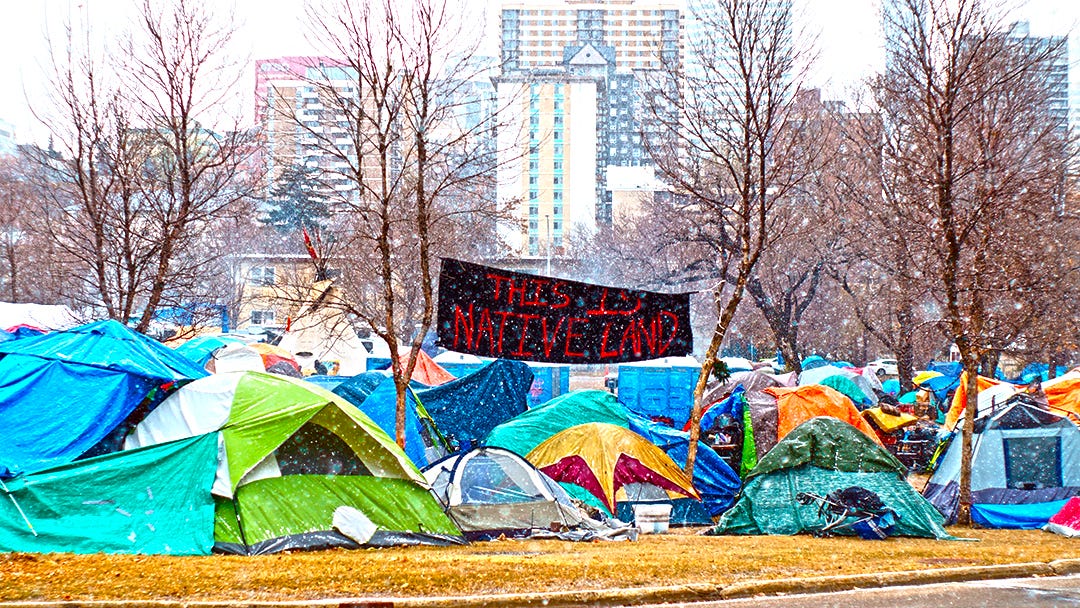
Homelessness in Canada is no longer concentrated in major urban centres—it is spreading rapidly through small towns and mid-sized cities, overwhelming communities that lack the resources to respond. From St. Catharines and Owen Sound to Barrie, Windsor, and rural Ontario, residents report rising tent encampments, open drug use, public disorder, and growing safety concerns in downtown cores that were once stable and accessible.
The scale of the problem is expanding quickly. A federal “Point in Time” count estimated nearly 60,000 people homeless on a single night across 74 communities in late 2024, while the Association of Municipalities of Ontario puts the number closer to 80,000 people province-wide—figures that local officials widely acknowledge are undercounts. What is most striking is not just the numbers, but the geography: homelessness is now firmly embedded in smaller communities that were never designed to absorb it.
This expansion closely tracks alongside Canada’s worsening affordability crisis. Housing costs have surged far faster than wages, vacancy rates remain near historic lows, and even modest rents are out of reach for many working Canadians. At the same time, record-high immigration levels have dramatically increased demand for housing, health care, and social services without a corresponding expansion in supply. Small towns, in particular, are being turned into overflow zones—hosting shelters, treatment centres, and encampments while lacking jobs, transit, or affordable housing stock.
The result is a system under visible strain. Encampments are cleared and quickly re-form. Police and emergency services are stretched thin. Harm-reduction programs coexist with rising addiction and overdose deaths, driven by increasingly potent synthetic drugs. Businesses report declining foot traffic and theft, while residents say they feel unsafe and unheard. In response, public opinion is hardening: nearly 60 percent of Canadians now support emergency measures to remove encampments from parks and public spaces.
What was once framed as a big-city problem is now a national one—and an accelerating one. As affordability deteriorates, population growth outpaces infrastructure, and governments struggle to impose order or accountability, homelessness is becoming a permanent feature of Canadian life. For many communities, the fear is no longer whether conditions will worsen, but how much worse they can get and how long residents will tolerate it before choosing to leave.
“They Were His Words”: Poilievre Responds to Questions on Michael Ma’s Floor Crossing

Floor crossing returned to the centre of Canada’s political debate this week following an exchange between CBC’s Rosemary Barton and Conservative leader Pierre Poilievre over Michael Ma’s decision to leave the Conservative caucus and join Mark Carney’s Liberals.
During the interview, Barton pressed Poilievre on whether the defection of two MPs from his caucus reflected a leadership issue. “I know you don’t like it, and we can talk about the merits of floor crossing and whether it should be allowed, but it is allowed,” Barton said. “Is this a sign of a weakness in your leadership that two members of your caucus have left?”
Poilievre rejected that characterization. “No,” he replied. “It’s a sign of backroom dealings that will drive up the cost of living.”
Rather than speculate on motives, Poilievre pointed to statements made by Michael Ma only weeks before his floor crossing. Quoting Ma directly, Poilievre read from remarks criticizing Liberal economic policy and deficit spending.
“We are in a shameful situation in this country where over two million Canadians are visiting food banks every month,” Ma had said. “At the end of every month, paycheques are not going far enough.”
Ma went on to argue that inflation was not simply a result of trade deficits. “There’s a simple economic fact,” he said. “When we create more units of currency and map them into the economy that is not meaningfully producing more goods and services, we get inflation.”
As a specific example, Ma cited rising food prices. “In the last five years, grocery prices have risen more than 20 percent,” he said, attributing that increase to deficit spending under Mark Carney.
Barton challenged Poilievre on the authorship of those remarks, suggesting it was possible Ma had not written them himself. Poilievre pushed back, responding, “They were his words.”
Ma’s defection has practical implications beyond caucus dynamics. With his move, the Liberal government now sits one seat shy of a majority in the House of Commons, strengthening Carney’s position in Parliament without a general election.
Floor crossing is permitted under Canada’s parliamentary system, and MPs are not legally bound to remain with the party under which they were elected. Still, the episode has renewed attention on the gap between procedural rules and public expectations, particularly when recent public statements appear to conflict with a sudden change in party alignment.
The exchange between Barton and Poilievre underscored that tension, highlighting how floor crossing continues to raise questions not about legality, but about accountability, timing, and the role of voter consent in a minority Parliament. Source.

FBI: 4 Arrested for Plotting Multiple NYE Terror Attacks in California

Federal authorities disrupted a “massive and horrific terror plot” by the extremist group Turtle Island Liberation Front, which allegedly planned a series of bombings in Orange County and Los Angeles, California, on New Year’s Eve. Described by officials as a “far-left, pro-Palestine, anti-government and anti-capitalist” group, the suspects also planned to target ICE agents and vehicles.
Four individuals—Audrey Illeene Carroll, Zachary Aaron Page, Dante Gaffield, and Tina Lai—were arrested and charged with conspiracy and possession of unregistered destructive devices after assembling improvised explosives in a desert location. The devices were reportedly intended to detonate at multiple logistics centers at midnight on New Year’s Eve.
FBI officials said the group is a violent, homegrown anti-government faction. A fifth person believed to be linked to the group was separately arrested in New Orleans for allegedly planning another violent attack. All four California suspects are set to appear in federal court. More
Hanukkah Massacre Sparks Overhaul of Australia’s Gun Laws

A father-son duo opened fire at a Hanukkah festival in Bondi Beach, Sydney, killing 15 people—including a child—and injuring 40 more on Dec. 14, 2025. One shooter had held a legal firearms licence for about a decade and owned six registered guns. In response, Australia’s National Cabinet announced plans to strengthen the National Firearms Register, limit guns per person, restrict types of firearms, require citizenship for ownership, and tighten controls on imports and new technologies like 3D-printed weapons. Authorities are reviewing the shooters’ backgrounds and motives, while NSW Premier Chris Minns pledged legislative reform if licensing gaps are found. The attack has intensified scrutiny on gun licensing and the country’s ability to prevent extremist violence. More
Syria Arrests 5 Over Suspected Ties to Deadly Ambush of the US and Syrian Military Convoy That Killed 3 Americans - More
Russia-Ukraine Peace Deal Updates:
US Extends ‘Robust’ Security Guarantees to Ukraine as Part of Peace Negotiations - More
Russia ‘Open’ to EU Membership as Ukraine Peace Talks Continue to Progress - More
Authorities to Release Person of Interest Detained in Brown University Shooting: Shooter Still at Large - More
Right-Wing Candidate José Antonio Kast Wins Chile Presidency Amid Fears of Crime and Mass Migration - More
Hong Kong Media Tycoon Jimmy Lai Found Guilty On All Charges in Landmark National Security Trial - Lai was found guilty on two counts of colluding with foreign forces and conspiring to publish seditious material, with sentencing pending. Court filings show contested procedures: Lai was denied jury trial and counsel choice, three judges were Beijing-appointed, and a so-called ‘witness’ who was allegedly tortured testified. More
South Korean Probe Says Former President Yoon Plotted Martial Law to Eliminate Rivals - Independent prosecutors say the former leader sought to manufacture a security crisis to dismantle democratic checks. More

Canadian Food Prices Rise at Fastest Pace in Two Years

In November 2025, food prices in Canada surged 4.7% year-over-year—the fastest pace since December 2023—despite overall inflation holding at 2.2%, Statistics Canada reported. Key price jumps included fresh and frozen beef, up 17.7%, and coffee, up 27.8%, driven by low North American cattle herds, droughts, and U.S. tariffs. Rental costs rose 4.7%, slowing from October’s 5.2% increase. Core inflation measures eased slightly, with CPI-median and CPI-trim both at 2.8%, while CPI excluding food and energy climbed 2.4%. Cellular service prices jumped 12.7%, and gasoline fell 7.8%. Economists expect headline inflation to fluctuate in the short term but anticipate core inflation to gradually return to the Bank of Canada’s 2% target by early 2027. More
CREA: November Home Sales Down Almost 11% Annually as Market Hits ‘Holding Pattern’ - More
Roomba Maker iRobot Has Filed for Bankruptcy - More
Canopy Growth to Buy MTL Cannabis for $179M, Poised to Lead Canada’s Medical Cannabis Market - More

ADHD Isn’t Just a Deficit: New Study Reveals Powerful Psychological Strengths

A new international study suggests adults with ADHD may possess untapped advantages over neurotypical peers when they harness their natural strengths. Researchers from the University of Bath, King’s College London, and Radboud University Medical Center in the Netherlands conducted a large-scale study comparing 200 adults with ADHD to 200 without, examining 25 positive traits such as creativity, humour, and hyperfocus.
While ADHD is often linked to challenges like impulsivity and inattention, the study found that adults with ADHD more strongly endorsed 10 strengths than neurotypical adults: hyperfocus, humour, creativity, spontaneity, intuitiveness, emotional insight, curiosity, empathy, determination, and risk-taking. When individuals recognized and actively used these traits, they reported higher well-being, better quality of life, and fewer mental health struggles.
Lead researcher Luca Hargitai emphasized that these ADHD-related strengths could allow adults to excel in ways neurotypical individuals may not. Senior author Dr. Punit Shah noted that strengths-based interventions could help people with ADHD turn these traits into tangible advantages, framing ADHD not solely as a disorder, but as a potential evolutionary edge for creativity, problem-solving, and adaptability. More
Scientists Develop New Fish-Inspired Filter That Removes Over 99% of Microplastics - More
Study: Sleep Predicts Longevity Better Than Diet or Exercise–Prioritizing Rest Could Be Key to a Longer, Healthier Life - More

Rob and Michele Reiner Murdered: Son Arrested in Stabbing Deaths

Nick Reiner, 32, has been arrested following the stabbing deaths of his parents, Rob and Michele Reiner, in their Brentwood, Los Angeles home. LAPD Chief Jim McDonnell confirmed that Nick was booked on murder charges and is being held on $4 million bail.
Rob Reiner, 78, was a celebrated actor, director, and producer, known for his role in All in the Family and for directing iconic films including When Harry Met Sally, The Princess Bride, and A Few Good Men. His wife Michele, 68, was a professional photographer.
The Reiners’ family expressed deep sorrow, asking for privacy during this tragic time. California Gov. Gavin Newsom also released a statement mourning their passing and recognizing Rob Reiner’s significant contributions to film and culture.
Nick Reiner had publicly struggled with drug addiction and periods of homelessness, which his parents had addressed in past interviews, reflecting on the challenges of supporting him through rehab and recovery. More
Scottie Scheffler Puts a Bow Tie on 2025 Winning PGA Tour Player of the Year for the 4th Year in a Row—Aldritch Potgieter was Named Rookie of the Year - More
Diego Pavia Loses Eight-Figure NFL Deal After Criticizing Heisman Judges, Fails to Avoid Shedeur Sanders’ Draft Slide Mistakes - More
Win Now, Pay Later—LA Dodgers’ Deferred Payment Obligations Surpass $1 Billion After Signing Edwin Díaz - More

’Slop’ Is Merriam-Webster’s 2025 Word of the Year as AI Content Floods the Internet
Chinese Humanoid Robot Sets Guinness World Record by Walking 106 Kilometres Nonstop Over Three Days
On This Day in 1773, the Boston Tea Party sparked revolutionary Tension. In a dramatic protest against the British-imposed Tea Act and escalating “taxation without representation,” members of the Sons of Liberty dumped entire shipments of tea into Boston Harbour. This bold act of defiance inflamed tensions between the American colonies and Britain, tipping the political and public mood toward open rebellion and setting the stage for the Revolutionary War that would erupt just two years later.