


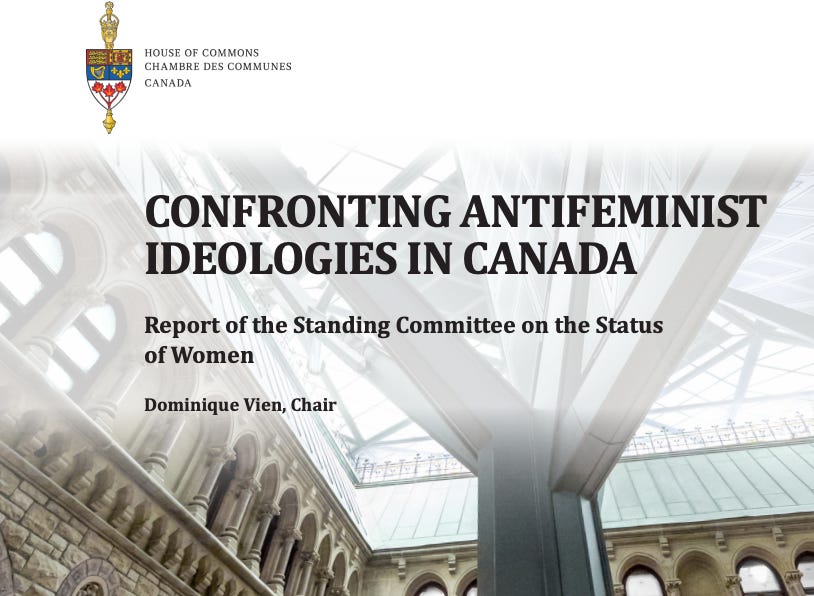
Last month, the federal government used your hard-earned tax dollars to produce a report titled “CONFRONTING ANTIFEMINIST IDEOLOGIES IN CANADA.” It's one of the most ridiculous things I've read from this Liberal government, which is no small feat after the last 12 years. It frames virtually any skepticism toward modern feminism, criticism of certain gender policies, or men’s online spaces as “antifeminist ideologies,” an “extremist ideology based on gender” that is supposedly “one of the fastest-growing extremist ideologies in the West,” a backlash harming everyone, fueling violence against women and “gender-diverse people,” and undermining “progress towards gender equality.”
It draws on witness testimony, cherry-picked stats, and loaded framing to justify more government spending, online regulation, “awareness campaigns,” digital literacy programs to spot “mis and disinformation,” DEI pushes, and early “intervention” for young men and boys at risk of “radicalization into ideologically motivated violent extremism—especially extreme antifeminist movements.”
So here are the top-5 reasons why Canada’s ‘Antifeminist Ideologies’ report is pure institutional propaganda, broken down with the actual claims versus reality and a corresponding bullshit meter, because the committee clearly wrote this after eating a box of expired crayons.
1. The Premise: “Antifeminism” as Extremist Ideology
The report defines antifeminist ideologies as regressive efforts to undo women’s rights, promote myths like “gender equality has been achieved,” “advancing equality harms society,” “women deserve violation,” “gender symmetry in violence,” and that “feminism has caused a crisis of masculinity.” It calls them “extremist,” intersecting with other bad stuff normalized online, especially among young men via the “manosphere.”
Bullshit level: Nuclear.
This is textbook motte-and-bailey. Reasonable critiques of specific modern feminist policies or claims (e.g., denial of biological sex differences in interests and behavior, family court biases favoring mothers, due process failures in #MeToo, boys falling behind in education, male suicide rates 3-4x higher, workplace deaths overwhelmingly male, and conscription history) get lumped in with fringe misogyny. “Antifeminism” here just means “anything challenging the narrative that all disparities are oppression and feminism is pure good.” Labeling dissent as extremism is how institutions shut down debate. Many “antifeminist” views are evidence-based pushback against overreach, not hatred.
2. “Fastest-Growing Extremist Ideology” + Links to Violence
It claims these ideologies are gaining momentum, becoming normalized, and link to violent extremism and gender-based violence (citing things like the Nova Scotia Mass Casualty Commission). Young people (15-24) are most exposed to “online content inciting hate or violence” (71% per some StatCan data vs. 49% national average). A 2025 UNESCO Chair survey allegedly shows 30% of francophone 18-34-year-olds see feminism as a “strategy to control society,” with 40% of anglophone men saying equality is achieved, so feminism is unnecessary.
Bullshit level: High.
There is no rigorous, non-circular evidence that “antifeminism” is a distinct, fast-growing extremist ideology driving violence. Real extremism data (CSIS, etc.) focuses on Islamist terrorism, far-right, far-left, etc., not broad skepticism about feminism. The Nova Scotia shooter had severe mental health issues, a domestic abuse history, and other factors; tying it primarily to “antifeminist ideology” is post-hoc narrative fitting.
Most men exposed to men’s online spaces don’t commit violence. Higher male suicide, substance abuse, and incarceration are real, but attributing them mainly to “toxic masculinity” or patriarchy ignores biology (testosterone, risk-taking, lower agreeableness on average), economic pressures, and other cultural factors. The survey numbers actually show widespread reasonable skepticism, not extremism. The report treats pushback against radical claims—such as “all men are oppressors” or denying biological sex in sports, prisons, and schools—as a societal threat. That’s pure projection.
3. “Toxic Masculinity,” Types of Masculinities, and Gender Symmetry in Violence
The report calls traditional masculinity ideals (strength, stoicism, and emotional restraint) “toxic masculinity” that harms men by discouraging help-seeking and links them to misogyny and violence. It says men benefit from “patriarchy” in earnings/representation but suffer elsewhere. It explicitly calls “gender symmetry in violence” a myth pushed by antifeminists.
Bullshit level: Maximum.
“Toxic masculinity” is gender-studies jargon, not science. It pathologizes normal male traits evolved for protection, provision, and competition. Stoicism has upsides, like resilience, and emotional suppression isn’t uniquely “toxic,” it’s context-dependent. While men are overrepresented in overall violent crime, female perpetration in intimate partner violence is substantial and often bidirectional (meta-analyses like Archer 2000 and Canadian and U.S. data from NISVS / StatCan show women initiate or are violent in many non-lethal cases). Severe injury/homicide asymmetry exists, but “symmetry” isn’t a myth—it’s documented. Dismissing this as a “myth” lets the report ignore mutual violence dynamics and female perpetration.
Men do have real disadvantages (suicide, homelessness, education gaps where girls outperform boys, and workplace fatalities). Framing everything as patriarchy harming men “too” while demanding more pro-feminist interventions is incoherent.
4. The “Manosphere,” Influencers, and Online Harms
It singles out the manosphere and antifeminist influencers as key vectors spreading this, shaping discourse harmfully, especially for young Canadians.

Bullshit level: Very high.
Broad-brush smear. The “manosphere” is a loose category including everything from legitimate discussions of male issues (suicide, false accusations, education, custody) to toxic fringes. Influencers vary wildly. Some promote responsibility and self-improvement; others are grifters. Blaming online spaces for societal issues while ignoring real data on boys’ declining outcomes (education, mental health) and family policy failures is just lazy. “Harmful content” is subjective; regulating platforms for it (see Recommendation 3 below) risks censoring dissent under vague “safety” pretexts. Young people seeing “hate” content often means encountering views that contradict progressive orthodoxy.
5. The Recommendations (The Real Agenda)
And now we get to the real reason this report exists—government recommendations to fix this crisis:
Government awareness campaigns to “counteract antifeminist rhetoric” targeting parents/youth/young men, i.e., more government propaganda.
More funding for Canadian media. Lmfao…
Legislation regulating online platforms (moderation of “harmful content,” transparency, protecting children), aka censorship.
Digital literacy programs to recognize “mis and disinformation,” or a Ministry of Truth.
Support women in politics + measures against “gender-based political violence.”
More financial support for DEI programs for women and 2SLGBTQIA+…because you can never have enough.
Engage men/boys to advance gender equality, promote “healthy masculinities (which apparently don’t exist),” combat antifeminism, and intervene early against radicalization into “extreme antifeminist movements.” This literally sounds like brainwashing.
More research on antifeminist ideologies and their intersections with gender-based violence and coercive control. In other words, more research funding to produce more biased reports reinforcing this narrative.
Bullshit level: Off the charts.
This is state-sponsored ideological enforcement.
Bottom Line
This report isn’t neutral analysis, it’s a committee document pushing a specific worldview: modern feminism (broadly defined) is unassailable progress, and any pushback is dangerous extremism requiring government countermeasures. It ignores or downplays biological sex differences (well-established in psychology, endocrinology, evolutionary biology), outcome gaps driven by preferences or choices, and legitimate policy critiques. It weaponizes “violence” and “extremism” to pathologize normal discontent, especially among young men facing real headwinds.
The “insane” part is the total lack of self-awareness: a government committee on the “Status of Women” treating broad skepticism about its own ideological framework as a national security-adjacent threat while demanding more power to suppress it. Classic institutional overreach.
This thing is a textbook example of why trust in these institutions has completely eroded.
The Canadian Heritage department of the federal government offers grants aver $100k for reports supporting these recommendations.
Get on the bandwagon and do a report. The format is available from the Digital Citizen Program.
It was originally constituted to have citizens help governments pushback against COVID 19 regulation complaints. In other words, the citizens didn’t believe the government hysteria and the feds didn’t understand why citizens had scepticism about their “control” agenda.
The referenced report was likely prepared with taxpayer’s funds and government coaching.
If the first page of the report included a Land Acknowledgement, then it was a Canadian Heritage funded narrative.
Be very afraid.
Oh how Canada has lost its way!