


Good morning, it’s Wednesday, December 3rd. In today’s news, an alleged vote-buying scandal exposes Canada’s dysfunctional democracy, Canada will enter 2026 USMCA negotiations with no leverage, a NDP leadership candidate says pipelines cause rape and murder, law enforcement agencies seize 386 kilograms of fentanyl, and much more.
First time reading the daily blend? Sign up here.

Alleged Vote-Buying in Liberal Leadership Race Exposes Canada’s Dysfunctional Democracy
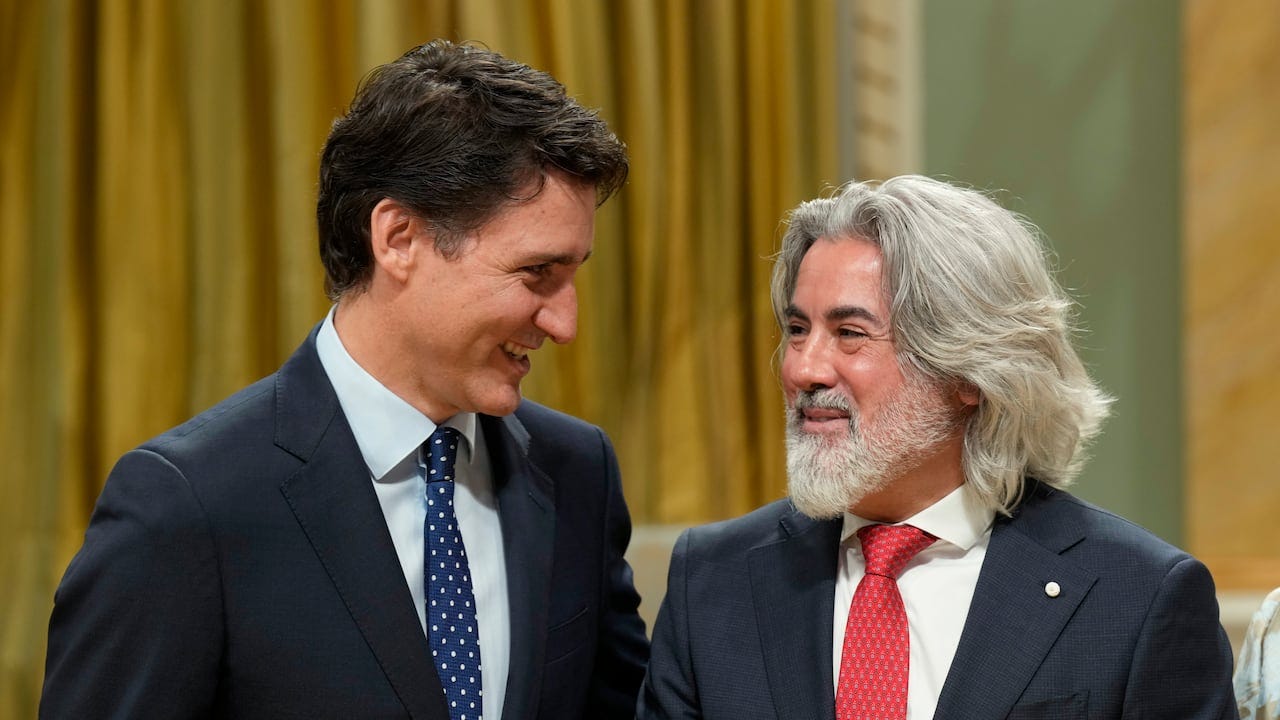
Canada has spent the better part of a decade investigating how political power gets bent behind closed doors. We have held a federal inquiry into foreign interference. We have held a provincial inquiry into illegal political financing. Both delivered the same lesson: leadership contests and nomination races are the soft underbelly of our democracy. And yet, as the latest scandal inside the Quebec Liberal Party shows, we chose not to learn it.
The crisis now engulfing the Quebec Liberals centres on Pablo Rodriguez, Justin Trudeau’s long-time Quebec organizer and one of the most influential figures in the Liberal machine. Élections Québec is examining text messages suggesting that some supporters in Rodriguez’s leadership bid were rewarded with cash in connection with their votes and membership cards. Quebec’s anti-corruption unit has begun early work, interviewing former caucus leader Marwah Rizqy and opening the door to potential investigations of corruption, fraud, breach of trust, or influence-peddling.
The party responded by attacking the journalists who broke the story and launching its own internal review. It is the same pattern we have seen during every Liberal crisis of the past decade: deny, counterattack, and hope procedural fog buys time.
But the story is larger than Rodriguez. It is about the structural gap Canada refuses to close. Under Quebec’s Election Act, it is not explicitly illegal to pay someone for their vote in a leadership race. Vote-buying in a general election can lead to fines and criminal penalties. The same act says nothing when the vote determines who could become premier. This is the loophole foreign actors, corrupt networks, and party insiders can exploit because the law treats internal party races as private rituals rather than moments of democratic consequence.
The Hogue Commission warned that party nominations and leadership contests are gateways for manipulation. The Charbonneau Commission, nearly a decade earlier, showed how illegal money seeped into Quebec’s political bloodstream and opened doors for organized crime. Both inquiries made the vulnerabilities unmistakable.
Yet here we are again. A federal Liberal MP, Fayçal El-Khoury, initially denied involvement in the race until reporters uncovered his solicitor’s certificate authorizing him to raise money for Rodriguez. Lists of these fundraisers are not public. Without investigative journalism, voters would never know who is shaping these contests.
There is no proof yet of foreign interference or criminal actors. But the facts already show a deeper problem: Canada continues to run leadership races in legal shadows. Until these contests are treated like real elections, the same scandals will loop forever, and public trust will keep sinking. Source.
Canada Will Enter 2026 USMCA Negotiations with No Leverage and the Liberals Already Want You to Blame Trump
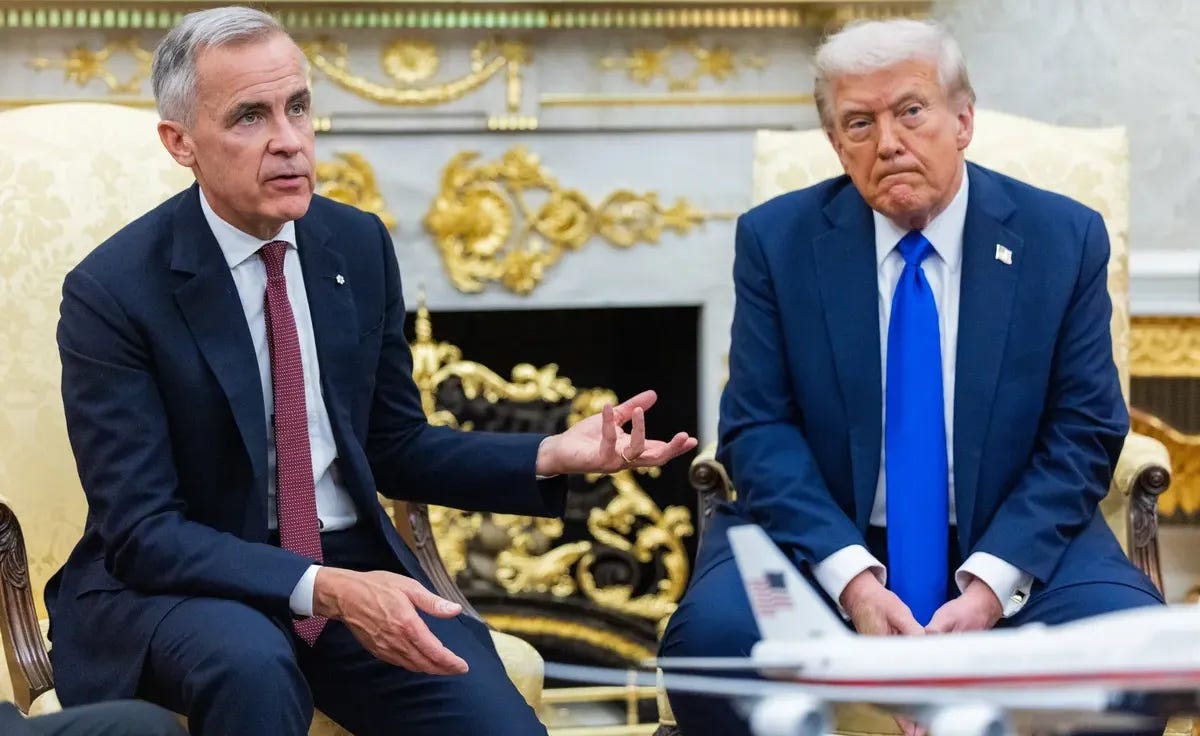
Canada is heading into the 2026 USMCA review in its weakest negotiating position in decades—yet the Carney government is already priming Canadians to blame President Trump instead of taking responsibility for its own strategic failures. While Trump has opened negotiations this year with major economies at record speed, talks with Canada have been effectively frozen. Prime Minister Mark Carney has spent months trying to appease Trump on tariffs hitting Canada’s auto, steel, and aluminum sectors—but the olive-branch routine was doomed from the start, undermined by the Liberals’ own counter-tariff chest-thumping just months earlier.
The relationship deteriorated further after Trump suspended talks on Oct. 23, triggered by an Ontario government ad featuring Ronald Reagan criticizing tariffs—an avoidable, self-inflicted irritant that handed Washington an excuse to walk away. Now, with no clear path back to discussions, Carney is heading to Washington for the World Cup draw—not for actual diplomacy—meaning Canada enters 2026 with no leverage, no plan, and no progress.
Canadians seem to sense the failure. According to new Nanos polling, 67% believe it’s unlikely Canada will strike a tariff-reducing deal with the US in the next six months, a damning sign of waning public confidence. And critics warn it’s about to get worse. Barry Appleton, a respected international trade lawyer, says Trump could open 2026 by threatening US withdrawal from USMCA—an aggressive but fully legal move that would force Canada and Mexico into two separate, bilateral battles. In that scenario, Washington would have an overwhelming advantage, and Canada—having failed to build leverage, diversify trade, or articulate a coherent industrial strategy—would be negotiating from a place of near-total weakness.
This isn’t a surprise; it’s the predictable outcome of years of misguided trade posturing and political theatre from Ottawa. Instead of preparing for the USMCA review through stronger domestic competitiveness, meaningful industrial policy, or a unified provincial-federal front, the Liberal government has acted as if goodwill alone could sway Trump. Now, with negotiations stalled, Canada is exposed, outmaneuvered, and unprepared.
Bottom line: Ottawa is setting Canadians up to blame President Trump for whatever economic pain comes next, but the hard truth is this: Canada positioned itself terribly for the USMCA review, ignored warning signs for years, and failed to protect its own leverage. When the trade pressure hits in 2026, it won’t be Trump who failed Canadians—it’ll be the Canadian leaders who never showed up ready to fight.
NDP Leadership Candidate Says Pipelines Cause Rape and Murder

Canada’s politics have entered a strange place when a leading NDP leadership candidate can claim — with a straight face — that pipelines are a gateway to rape and murder. Yet that’s exactly what Avi Lewis told the country during the party’s French-language debate. He warned that Mark Carney’s push for nation-building projects would unleash “big, manly things” with remote work camps that endanger Indigenous women.
It’s the kind of claim that spreads fast because it sounds grim, righteous, and unchallengeable. But it has a problem: the evidence behind it is paper-thin.
This idea didn’t start with Lewis. Activist groups have spent years framing industrial projects as tools of “extractive violence,” turning pipeline workers into a kind of roaming threat. Since 2017, campaigns against Trans Mountain, Coastal GasLink, and other projects have leaned heavily on the term “man camps.” Stand.Earth, Amnesty International, and various anti-oil groups argued that the very presence of temporary work sites brings murder, trafficking, and sexual assault.
The problem? Much of the “research” behind these claims collapses under the slightest weight.
The National Inquiry into Missing and Murdered Indigenous Women and Girls helped popularize the idea by citing a handful of loosely linked reports — none of which provided firm evidence that pipelines drive higher violence against Indigenous women. One cited report admitted it had “no comprehensive data.” Another focused on feelings of unsafety, not measurable harm. A third leaned on a tiny RCMP sample around a mine site, where a supposed 38 per cent spike in sexual assaults meant a rise from 16 cases to 22 — in a single year — with no wider trend to confirm causation.
This is what passes for proof in activist circles: thin data, vague claims, and a web of citations that loop back to the same untested assumptions. Meanwhile, every major project continues to face costly delays, legal challenges, and public mistrust built on narratives that fall apart when checked.
Violence against Indigenous women is real and serious—rates of sexual abuse on reserves is three times higher than the national average—but using it as a rhetorical weapon to block infrastructure does nothing to make anyone safer. It only deepens distrust, halts economic growth, and treats hard-working Canadians as if they are predators by default.
Pipelines are not a conduit to rape and murder. But hysteria, when left unchecked, can be a conduit to bad policy — and Canada has had more than enough of that. Source.
☕ Join Canada’s Coffee Revolution and Make Some Money While You’re At It 💰
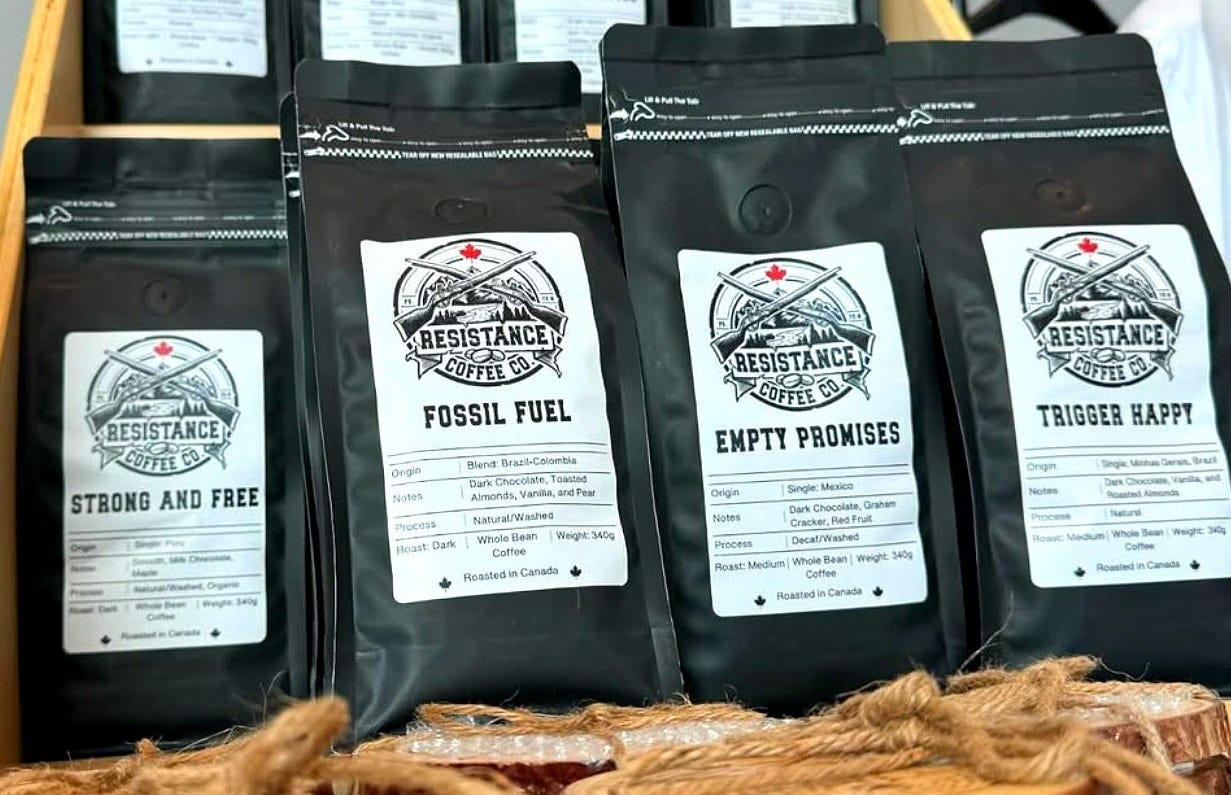
Join the Resistance Coffee Co. Outpost program and be part of a Canadian-made, freedom-first coffee movement.
As an Outpost, you’ll share and distribute high-quality coffee in your community, earn money for every bag sold in your area, and enjoy free coffee and free shipping—whether you sell it yourself or just help get it out there.
Signing up is simple: go to resistancecoffee.com, apply to be an Outpost, and check “Referred by Blendr” for an extra bag of free coffee when you join.
Support Canadian coffee, earn some independence, and start your Outpost today.

Canadian Law Enforcement Agencies Seize 386 Kilos of Fentanyl in 5-Month National Initiative

Canada’s fentanyl crisis is bigger than many realize. A nationwide law enforcement operation, National Fentanyl Sprint 2.0, seized 386 kilograms of fentanyl—78% of the year’s total—in just five months, along with huge quantities of cocaine, meth, heroin, and precursor chemicals. The initiative involved more than 100 agencies, 1,068 search warrants, and 8,136 arrests and charges, highlighting the scale of domestic trafficking.
Most fentanyl seizures occurred in Ontario and British Columbia, and authorities say the majority is destined for the Canadian market, not the US. With over 50,000 Canadians dead since the crisis began—and 8,000 this year alone—experts warn that domestic organized crime has built a sophisticated manufacturing and distribution network. Officials acknowledge the crisis is national, relentless, and far larger than previously understood. More
Over 120,000 Home Cameras Hacked in South Korea in Massive ‘Sexploitation’ Scandal
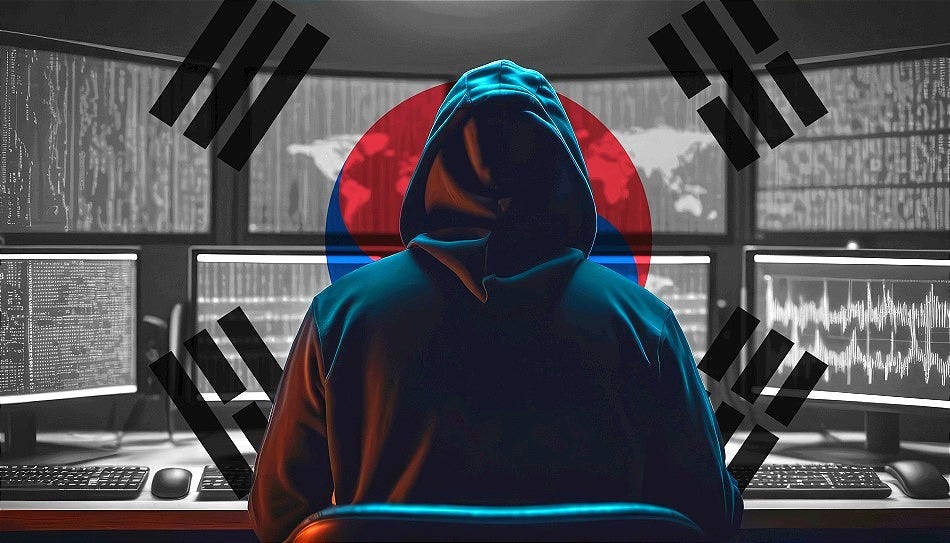
Four people in South Korea have been arrested for allegedly hacking over 120,000 home and business IP cameras to create sexually exploitative videos for an overseas website. The suspects exploited weak passwords on cameras installed for security or monitoring children and pets, targeting locations including private homes, studios, and clinics.
Two of the suspects were responsible for about 62% of videos on the site, earning tens of millions of won in virtual assets. Authorities are moving to shut down the website, coordinating with international agencies, and have arrested three individuals who purchased the illegal content.
Police are notifying victims, helping them secure devices and delete content, and urging all IP camera users to remain vigilant and regularly update passwords. More
Study: Government Jobs Drove 30% of Canada’s Employment Growth Over Past Decade - Canada experienced a rise of 950,000 government sector jobs from 2015 to 2024 according to a recently-released report from the Fraser Institute.
US Homeland Security Calls for Travel Ban on Nations Sending ‘Criminals’ - The proposal comes after the shooting of two National Guard soldiers by an Afghan immigrant not far from the White House. More
Elizabeth May, Green Party Leader, Says Voting for Carney’s Budget was a ‘Mistake’ and it Won’t Happen Again - May’s change of heart came following the reversal of Enhanced Oil Recovery credits, calling the move a “significant betrayal.” More
Bulgaria Ditches 2026 Budget Plan After Tens of Thousands Join Protests - Critics of the abandoned budget plan said they were protesting against increases to social security contributions and taxes on dividends to finance higher spending, as well as state corruption. More
Calgary Man Found Guilty of Three Terrorism-Related Charges Tied to ISIS - Jamal Borhot, who is now 35, was convicted after being charged with travelling to Syria in 2013 to assist in the terrorist activities of ISIS. He faces up to 30 years in prison. More
Chinese and Japanese Boats Face Off Near Disputed Islands as Feud Worsens - More

Costco Sues Trump Admin for ‘Full Refund’ of Tariffs—Could Set Costly Precedent

Costco has sued the US government to secure a full refund of import duties if the Supreme Court strikes down President Trump’s use of emergency powers to impose tariffs without congressional approval. Two lower courts have already ruled that Trump exceeded his authority under the International Emergency Economic Powers Act (IEEPA), and the case now awaits the Supreme Court’s decision.
Costco argues that even if the high court affirms the rulings, refunds aren’t guaranteed without a separate judgment, noting that importers have already paid roughly $90 billion in IEEPA-related tariffs. The lawsuit highlights a potential precedent: if the Supreme Court limits the president’s emergency tariff authority, it could curb future unilateral trade actions and force the government to refund billions collected under such measures. More
Ontario’s Ford Government Fires Entire RECO Board, Promising to Fix ‘Total Mess’ at Real Estate Regulator - More
Laurentian Bank Announces Split Sale to Fairstone Bank and National Bank - The two deals will cumulatively bring $3.3 billion to the table. More
Starbucks Will Pay $38.9 Million to Settle NYC Probe Over Worker Schedules - New York City said that the coffee chain violated a local law requiring fast food businesses to give workers predictable and stable schedules more than half a million times over a three-year period. More

New State of Quantum Matter Could Power Future Space Tech

Researchers at UC Irvine have discovered a completely new type of quantum matter in a material called hafnium pentatelluride. In this state, tiny particles called electrons and their positive counterparts, called holes, move together in a strange, fluid-like pattern, forming structures known as excitons. Unlike in normal materials, these particles rotate in the same direction, creating unusual behaviours that could be harnessed in new technologies.
What makes this exciting is what it could do: because this material is resistant to radiation and can carry information in a different way than normal electronics—using particle spin instead of electrical charge—it could lead to energy-efficient computers or devices that can survive the harsh conditions of space. In other words, this discovery could help make self-charging computers, quantum devices, or electronics that work on Mars a reality.
In short, scientists have found a new “phase of matter”—like discovering a new state of water—that could transform how we build the next generation of super-efficient, space-ready technology. More
AI Uncovers 86,000 Hidden Earthquakes Under Yellowstone - Despite public fears, scientists emphasize that over 90 percent of Yellowstone’s earthquakes are magnitude two or smaller and pose no eruption threat. More
Wild Pigs Turned ‘Neon Blue’ in California, Triggering Warnings - “I’m not talking about a little blue—I’m talking about neon blue, blueberry blue,” said Dan Burton, owner of a wildlife control company. An investigation found the dramatic colour change was caused by rodenticide poisoning. More

Tiger Woods May Be Calling It a Career
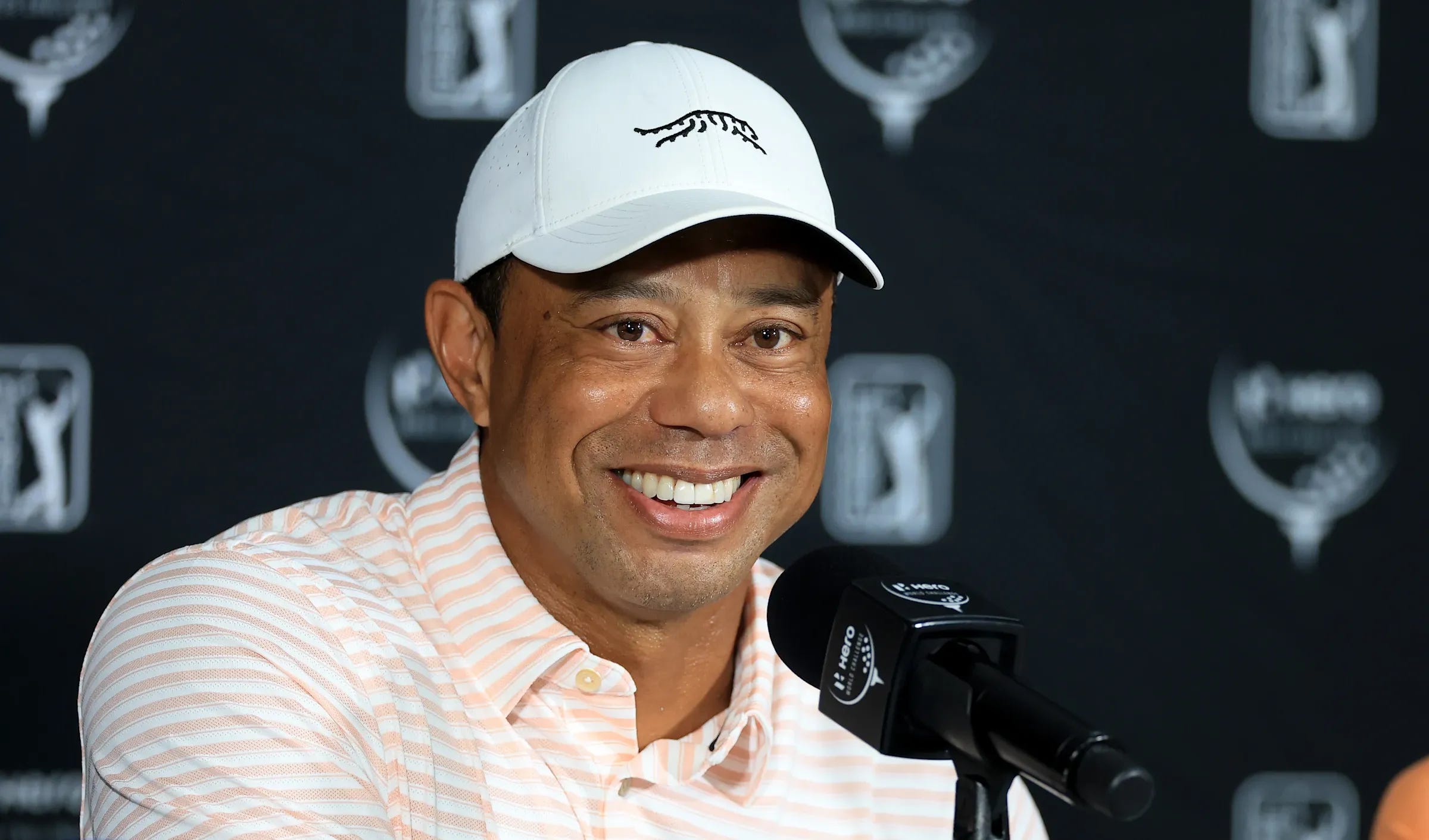
Tiger Woods kicked off the 2025 Hero World Challenge in the Bahamas with an update on his health, revealing he remains sidelined following another back surgery. Woods hasn’t played on the PGA Tour since the 2024 Open Championship and says he needs time to assess his body before deciding whether he’ll play in any more competitive events. For now, he’s ruling out both the PNC Challenge and the TGL indoor league.
Woods has started light training, including chipping, putting, and gym work, and emphasized that recovery from a disc replacement takes patience. He also reflected on the PGA Tour’s future as a member of the Future Competition Committee, noting efforts to balance player schedules, fan engagement, and financial opportunities.
“I’d like to come back to just playing golf again,” Woods said, calling 2025 a tough year and underscoring his cautious approach to any return. More
UFC Heavyweight Champ Tom Aspinall May Need Surgery on Both Eyes - The 32-year-old suffered the eye injury in his last title defence against Ciryl Gane at UFC 321 on Oct. 25, which ended in a no-contes. More
‘Stranger Things’ Finale: Netflix Reveals 500+ Movie Theater Locations and Sets Runtime at 2 Hours and 5 Minutes - More
WNBA’s Proposal Ups Max Salary Base to $1 Million - More
Quentin Tarantino Lists His Top 10 Movies of the 21st Century—Names ‘Black Hawk Down’ #1 - More

Civil Servant Gets Prison Time for Unlawfully Cashing Salary for 10 Years Without Going to Work
Fitness Influencer Dies After Consuming up to 10,000 Calories Per Day in an Attempt to Rapidly Gain 50 Pounds
On This Day in 1989, Soviet President Mikhail Gorbachev and US President George H. W. Bush formally declared the Cold War over, marking the end of decades of political tension, military rivalry, and nuclear standoff between the United States and the Soviet Union.