


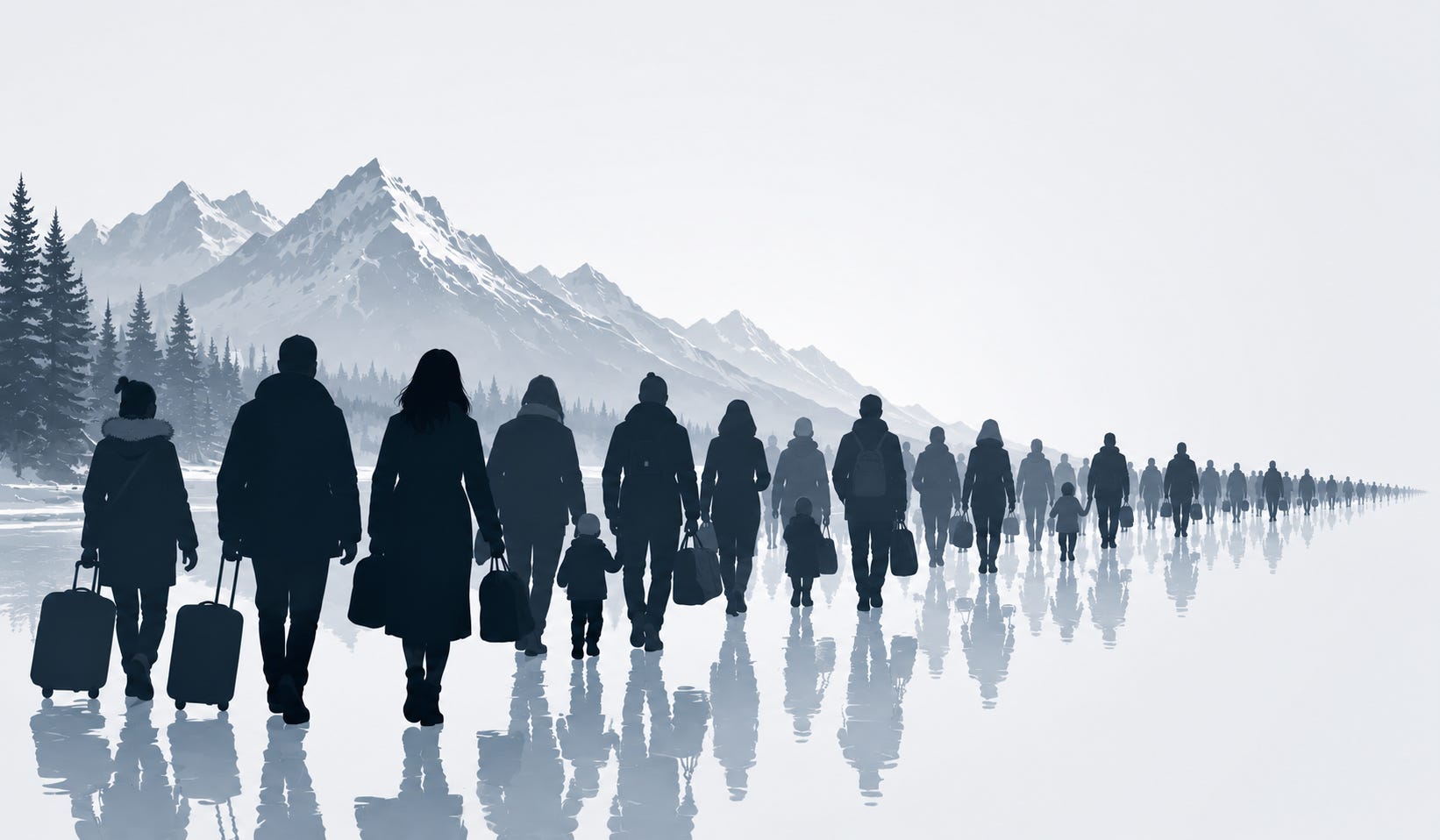
There’s a quiet trend happening in Canada that almost nobody in official circles wants to talk about. And it’s not immigration coming in. It’s Canadians — ambitious Canadians — looking at the country they grew up in, and getting out.
This includes young professionals, entrepreneurs, builders, and high earners.
A Bank of Canada staff working paper found that roughly 40% of Canadians who would rank in the top 1% of earners have already emigrated to the U.S., along with 30 to 50% of the next nine income percentiles. The same research finds these top earners account for roughly three-quarters of the Canada–U.S. GDP-per-adult gap.
In 2025, total Canadian emigration hit a record high of over 120,000 departures — the largest outflow in Canadian history. Emigration has nearly doubled over the past decade, surging 76.7% back in 2017 (from 67,893 to 119,964) and not surpassed until last year.
See, it used to be that leaving Canada was seen as risky. You left opportunity behind. You gave something up. But now, for a growing number of Canadians, staying feels like the risky decision.
The Math Stopped Working
In 1980, the average Canadian home cost about 2.8 years of household income. Today the price-to-income ratio is 8.4 times income. In cities like Toronto and Vancouver, it’s often well over ten years of income.
In 2025, Canada recorded 140,457 consumer insolvencies — the second-highest annual total ever recorded, behind only the aftermath of the 2009 financial crisis. That’s roughly 385 Canadians filing every day.
The Bank of Canada has noted that productivity growth has fallen from roughly 3% annually decades ago to below 0.5% today. In simple terms, productivity is how much economic value each worker creates.
If productivity grows: wages rise, businesses expand, and living standards improve. If productivity stagnates, wages stagnate, governments collect less revenue, and affordability gets worse.

As of 2024, business investment per worker in Canada was down 15% from what it was in 2014. Over the same period, the United States increased by 21% while the OECD average increased by 11%.
According to the Fraser Institute, the average Canadian family spends 42.3% of its income on taxes. Meanwhile, housing, food, and clothing combined account for 35.5% of income.
Federal government spending in 2025 reached approximately $547.3 billion — compared to $280 billion a decade ago. That’s roughly double, for anyone keeping score.
A G20 Outlier
Canada’s economy has now posted two consecutive quarters of contraction, which means we’re in a recession — the only country in the G20 currently in one. No other major economy in the world is.

As a result, Canadian investment abroad is closing in on $2.5 trillion — up nearly $700 billion in four years. Meanwhile, foreign direct investment in Canada has fallen to $1.60 trillion, creating a near $1 trillion gap. Canadians are now more invested in the rest of the world than the rest of the world is in Canada.
If that’s not enough, Canada’s Crime Severity Index rose from 66.9 in 2014 to 77.9 in 2024, with violent crime specifically rising from 70.7 to 99.9 over the same period. And roughly 6.5 million Canadians can’t find a family doctor, with about 15,000 dying annually on wait lists.
From Comfort to Feasibility
So Canadians aren’t just thinking about comfort anymore. They’re thinking about feasibility.
They’re asking whether the basic building blocks of life — a home, stability, maybe a family — are even realistic anymore. That changes how people think about a country.
And that’s the story here. Canada may still feel okay day-to-day, but more and more people are starting to feel like it’s becoming a harder place to build anything meaningful. A business, career, and future. Effectively, a life.
Meanwhile, you look at places like Texas or Florida, or even Dubai, and whether you love them or not, the signal is the same: faster growth, lower friction, and a stronger link between effort and outcome. That’s what people are really reacting to.
And here’s the bigger problem, Canada: once ambition starts flowing out of a country, it doesn’t come back anytime soon.
Simple, True, factual thought provoking report, thanks,Johnathan and Blendr News
Interesting fact: the government has no idea exactly how many Canadians are leaving the country, or how many foreign students or tourists leave.
Why?
Ever notice that when you leave Canada you never go through immigration and customs. Just security. Unlike most other countries we do not go through immigration and customs when entering and leaving and have an agent dutifully recording all the data.